
You have just poured a concrete slab to extend your living room into the garden, and a neighbor hints that this type of work must be reported to the tax authorities. The question then arises: should you declare this terrace, to whom, and in what order? Between urban planning procedures and tax obligations, the two circuits are distinct but linked. It’s better to understand their relationship before laying the last tile.
Fixed or removable terrace: the criterion that triggers taxation
It is often thought that only the surface matters. In practice, it is primarily the nature of the terrace that determines whether it falls under the tax radar. The criterion used by the administration is simple: a terrace that cannot be moved without demolition is considered an outbuilding, just like a garage or a conservatory.
You may also like : Everything You Need to Know to Care for Your Pets
In concrete terms, a terrace made of slabs placed on pedestals, removable without destruction, does not have the same status as a poured concrete slab or a masonry structure. The former does not change the cadastral value of the property. The latter does.
This point changes everything for what follows: if your terrace is fixed and permanent, it increases the cadastral rental value of your property. This impacts property tax and housing tax for second homes.
Related reading : What You Really Need to Know About Pôle emploi Services: Reviews and Practical Tips
Before starting the work, the question to resolve with your mason or craftsman is therefore about both the installation technique and the type of covering. You can also find the details of the tax declaration for terraces in specialized resources that detail each scenario.
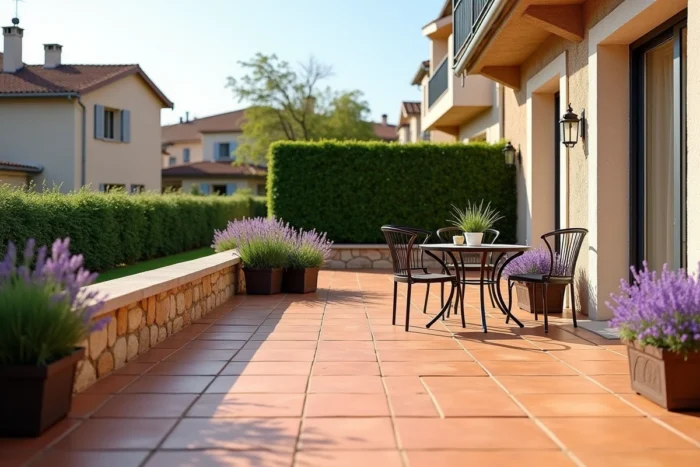
Urban planning and taxes: two distinct declarations for the same terrace
This is the point that most articles gloss over, and yet this is where errors accumulate. When building a terrace that requires urban planning authorization, a second tax declaration must then be made once the work is completed. The two circuits do not automatically communicate with each other.
The urban planning aspect depending on the type of terrace
At the municipal level, the rules depend on the height and area of the terrace. A ground-level terrace, placed at the level of the natural ground without elevation, generally does not require any urban planning authorization. Things change as soon as there is elevation.
- A low elevated terrace with a modest footprint requires a prior declaration of work submitted to the town hall.
- An elevated terrace over 60 cm with a significant footprint requires a building permit, with a more complete file (plans, landscaping integration).
- In all cases, the local urban planning plan (PLU) of your municipality may set specific constraints, particularly in protected areas or near a historical monument.
First and foremost, a visit to the urban planning department of the town hall allows you to verify the applicable rules for your plot. Responses vary on this point depending on the municipalities, some being stricter than others regarding the notion of “ground level”.
The tax aspect after the completion of the work
Once the terrace is finished, the second circuit is triggered. Since the generalization of the “Manage My Real Estate” (GMBI) space on impots.gouv.fr, the tax declaration is made online to update the rental value of the property. This declaration is distinct from the declaration of completion and compliance (DAACT) that you submit to the town hall.
In practice, you first submit the DAACT to the municipality, then log into GMBI to report the modification of your property. Both procedures are mandatory and complementary. Forgetting one exposes you to retroactive adjustments.
Tax audits on undeclared terraces: what has changed recently
In recent years, audits on undeclared outdoor structures have significantly intensified. The tax administration now cross-references cadastral data with aerial imagery, a method initially deployed to identify undeclared swimming pools and which is gradually extending to terraces, pergolas, and extensions.
Several local authorities and media have reported since 2024-2025 an acceleration of these checks. The penalties are not trivial: penalties for concealment can reach 80% of the taxes owed, in addition to the adjustment of unpaid tax amounts for past years.
The risk is not limited to your wallet. An undeclared terrace can also block a real estate sale. The notary, by checking the consistency between the cadastral records and the reality of the property, spots the anomaly. The transaction is then suspended until regularization, which can take several months.

Development tax and terrace: in which cases do we pay it
The development tax, collected by the municipality and the department, applies to constructions creating enclosed and covered surfaces with a ceiling height greater than 1.80 m, as well as to certain specific developments (swimming pools, parking spaces). An open and uncovered terrace does not fall within this scope.
However, if you cover your terrace with a fixed roof or integrate it into an enclosed volume, it falls within the perimeter of the development tax. The boundary is sometimes thin between an attached pergola and a conservatory, and it is the enclosed and covered nature that makes the difference.
- Open terrace without covering: no development tax, but update of the rental value if it is fixed.
- Terrace covered by a closed fixed structure: development tax applicable in addition to the cadastral update.
- Open pergola (not enclosed): generally exempt from development tax, but to be verified according to the local PLU.
The declaration of urban planning taxes is made after the completion of the work, even if you think you are exempt. The administration awaits this declaration to make a decision.
Form and deadline: the concrete steps to follow
For the urban planning aspect, the prior declaration of work form is available at the town hall or on the service-public.gouv.fr website. The file includes a location plan, a site plan, and sometimes photos of the existing situation. The processing time is generally one month for a prior declaration, longer for a building permit.
For the tax aspect, the update on GMBI must occur within 90 days following the completion of the work. You log into your personal space on impots.gouv.fr, access “Manage My Real Estate,” and declare the modification. The online form guides you through the steps.
Not waiting until the end of the 90 days to take care of it is still the best reflex. The earlier the declaration is made, the more you avoid forgetfulness and reminders. A property owner who voluntarily regularizes their situation faces much lower penalties than one who waits for an audit to react.