
Basta Gazales refers to a travel approach built around one principle: documenting the territories traversed rather than consuming them. Each destination becomes a field of investigation where geography, local practices, and economic constraints matter as much as the landscape.
Funding and editorial independence of a travel media
The structure behind Basta Gazales operates without advertising. This choice has a direct consequence on how travel content is produced: no tourist office, no airline, no accommodation provider finances or directs the topics.
The model relies on reader contributions. In the broader ecosystem of Basta!, individual donations account for 85% of the funding. This proportion makes the media vulnerable to fluctuations in generosity, but it ensures a stable editorial line.
An ad-free media freely chooses its destinations. When a traditional travel guide highlights a region because an advertiser requests it, a media funded by its readers can cover less touristy areas, crisis-stricken countries, or routes that no one sponsors. The travel section of Basta Gazales covers both rural French territories and West African countries, without hierarchy dictated by a marketing budget.
This operation is found in other independent editorial projects. In Normandy, Normandy Unpacked offers a reading of the Norman territory that breaks free from the circuits marked by tourist institutions.
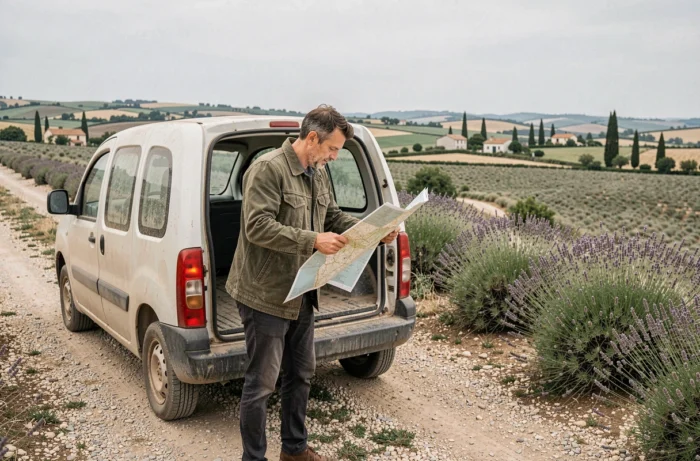
Travel vision at Basta Gazales: field and investigation
The travel as conceived by Basta Gazales is not a product to sell. The journey serves as a method to understand a territory, not to rate it on a satisfaction scale.
The field as a journalistic tool
Each travel report starts from a local question: how a community manages its water resources, why a road axis changes the economy of a valley, what land tensions cross a coastal area. The journey becomes a documentary investigation tool.
The journalists contributing to this type of content do not write “top 10 hotels.” They spend time on-site, meet local actors (farmers, elected officials, artisans, associative activists), and reconstruct causal chains. The reader does not receive a list of recommendations but a structured narrative that explains how a place functions.
The ecological question integrated into the narrative
The social and ecological editorial line of Basta! permeates the travel section. Covering a destination involves documenting its environmental footprint, its climate vulnerabilities, and its available modes of transport.
Traveling and documenting local alternatives are not two separate activities. An article about Senegal will address collective transport networks as well as markets. A report in Ardèche will cover forest management as well as hiking trails.
Organization of the editorial team and production of travel content
Basta! now has a team of 14 employees. This modest size imposes strict editorial choices: each travel topic must justify the time and resources mobilized.
- Topics are selected in editorial meetings based on their social relevance, not based on their click potential or visual attractiveness.
- Field reports require extended stays, which limits the number of destinations covered each year but increases the depth of each article.
- Fact-checking follows the same protocol as for social or economic investigations: cross-referenced sources, contradictory proofreading, contextualization of local data.
This rigor comes at a cost. Producing a documented travel report takes several weeks, whereas a traditional travel blog publishes an article in a few days. The publication rhythm is slow, but each piece provides a layer of information absent from tourist guides.
Portal for independent media and international coverage
Basta! is not limited to its own site. The media runs a portal for independent media, designed as a news feed without advertising or recommendation algorithms. This portal aggregates content from editorial teams that share the same requirement for financial independence.
For the travel section, this curation function has a concrete utility. A report published by a partner media in Burkina Faso or Colombia can complement an article from Basta Gazales on the same area. The reader accesses multiple angles without leaving a coherent editorial ecosystem.
The portal functions as an editorial mapping of the covered territories. Rather than an algorithm pushing the most clicked content, the selection relies on human choices. Social, environmental, and territorial themes structure the navigation.
The challenge of artificial intelligence for travel media
Artificial intelligence has become an explicit editorial topic for Basta!. Several independent editorial teams are raising alarms about the invisibility of their content by generative AI tools.
For an independent travel media, the risk is twofold. First, AI-generated responses can summarize a field report without citing the source, depriving the media of traffic and thus donations. Secondly, AI-produced travel content lacks the field verification that gives value to a documented report.
- A travel article written by AI compiles existing information without verifying its currency on the ground.
- Automatically generated recommendations reproduce the biases of the training data, favoring destinations that are already overrepresented online.
- The disappearance of independent sources in search results reduces the diversity of viewpoints accessible to travelers.
Travel and social alternatives: the editorial line in practice
Basta Gazales does not separate travel from its political and social context. An article about a French tourist region will address working conditions in seasonal hospitality. A report on a country in Africa will discuss local migration dynamics, not just natural reserves.
This approach fits into the broader editorial line of Basta!, which has been covering social movements, economic alternatives, and environmental issues since 2008. Travel is not a lifestyle supplement added to diversify the audience. It extends the investigative work on the territories.
Documenting a place means reporting on its tensions as well as its attractions. This requirement produces longer, denser, and less consensual articles than the average travel content online. It attracts an audience that seeks to understand the countries traversed, not just to visit them.
The model of Basta Gazales relies on a fragile balance between financial independence and production capacity. With 85% of its budget coming from donations, each field report represents an editorial bet. This operation excludes the race for volume, but it produces content that algorithms and sponsored guides will not replace anytime soon.