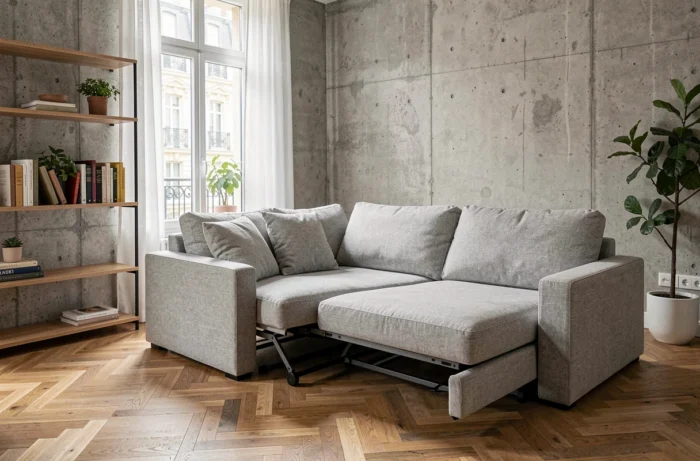
The convertible sofa combines two distinct normative references, that of domestic seating (NF EN 12520, NF EN 1728) and that of bedding (NF EN 1957). This dual requirement makes it a piece of furniture tested for intensive use in both configurations, a point that most buying guides overlook. Here are five technical and concrete reasons to incorporate it into a layout where every square meter counts.
1. Simultaneous compliance with seating and bedding standards
A classic sofa meets only the structural resistance standards for seating. A guest bed undergoes only the durability tests for bedding. The convertible, however, must satisfy both sets of tests: structural resistance NF EN 12520 and bedding durability NF EN 1957.
We recommend checking for the explicit presence of these two references on the product sheet. A model certified on both aspects ensures that the transformation mechanism does not degrade either the seating support or the mattress quality after several hundred opening and closing cycles.
This dual certification also has implications for owners of lodgings or tourist rentals. As soon as the accommodation falls under the status of a public establishment (ERP), the decree of June 25, 1980 requires a M3 classified structure and a NF D 60-013 test for upholstered seating, with a certificate valid for five years. By choosing a compliant convertible at the time of purchase, one avoids costly replacement during a fire safety inspection.
To delve deeper into the selection criteria, convertible sofas on Technique Habitat detail the technical points to check before buying.
2. Integrated mattress of sufficient density for daily sleeping
The difference between a guest convertible and a convertible for daily sleeping lies in one parameter: the mattress density. A mattress with too low a density will sag within a few months. Models designed for regular use come with mattresses whose density allows for proper support over time.

The type of mattress also plays a decisive role:
- High resilience foam: a good compromise between comfort and price, suitable for student studios or guest rooms used several times a month
- Memory foam: better pressure point distribution, preferred for a main sleeping arrangement in a small apartment
- Latex: superior natural ventilation, relevant in poorly ventilated rooms where the sofa remains closed during the day
A convertible mattress can be replaced independently of the structure. Checking dimensional compatibility before purchase allows for extending the furniture’s lifespan without having to buy a whole new unit.
3. Conversion mechanism suited to the living room configuration
Not all mechanisms are created equal, and the choice depends less on budget than on the room layout. A rapido (or Italian) mechanism deploys the bedding forward: it requires clearing at least the length of the mattress in front of the sofa. In a long living room, this is not always possible.
The clic-clac, on the other hand, unfolds along the backrest axis. It requires some space from the wall but no frontal clearance. In a studio where the sofa is pushed against a partition, the clic-clac remains the only usable mechanism without moving any furniture.
The BZ unfolds in an accordion style perpendicular to the wall. Its seat depth, more compact when folded, makes it suitable for narrow rooms. However, the sleeping surface obtained is often slightly smaller than that of a rapido.
We observe that the choice of mechanism also affects longevity: a rapido with a metal slat frame withstands frequent openings better than a clic-clac with simple hinges. For daily use, the sturdiness of the frame takes precedence over the folding type.
4. Integrated storage under the seat for bedding
In a studio or small apartment, the storage volume consumed by the duvet, sheets, and pillows is far from negligible. A convertible sofa with a storage compartment under the seat eliminates this problem.
The compartment is accessible either by lifting the seat (corner models) or by side opening. The usable volume of the compartment varies significantly from one model to another, even with identical external dimensions. Checking the actual depth of the compartment, and not just its surface area, avoids unpleasant surprises.
This integrated storage allows for the removal of a wardrobe or a dedicated linen chest, thus freeing up floor space. In a studio layout centered around the convertible, it is often this indirect gain that makes a difference in terms of circulation.
5. REP furniture channel and controlled end-of-life
Convertible sofas are now integrated into the extended producer responsibility (REP) scheme for furniture. In practical terms, the eco-participation paid at the time of purchase finances the collection and recycling at the end of life.
This regulatory framework has a direct consequence on the choice of model: manufacturers engaged in the REP scheme design structures that are easier to disassemble, with separable materials (wood, metal, foam, fabric). An eco-designed convertible disassembles into recyclable components, whereas a low-end glued and stapled model ends up in landfill.
For a responsible purchase, we recommend checking for the eco-organization identifier on the invoice. This detail, rarely mentioned in stores, confirms that the product is indeed part of the collection and recovery circuit at the end of its life.
The convertible sofa is not just a simple compromise between a sofa and a bed. It is a piece of furniture subject to two normative references, with the choice based on precise technical criteria: mattress density, type of mechanism, storage volume, and REP traceability. Starting from these parameters rather than just price or visual style remains the most reliable method for a sustainable purchase.