
The fennec attracts attention with its small size and oversized ears. However, adopting a fennec in France remains a complex process, governed by strict regulations on non-domestic animals. Before falling for this desert fox, some realities need to be clearly stated.
Certificate of capacity and prefectural authorization to keep a fennec
The fennec (Vulpes zerda) is classified as a wild non-domestic animal under French law. This means that it cannot be bought and kept like a cat or dog. Two administrative documents are required for its legal ownership.
The first is the certificate of capacity, issued by the Departmental Directorate for the Protection of Populations (DDPP). This document certifies that the future owner has the necessary knowledge to house and care for the species in question. Obtaining it requires proof of training or experience with wildlife.
The second is the prefectural authorization for possession, which validates the conditions of accommodation (size of the enclosure, security, facilities). Keeping a fennec without these authorizations can lead to one year of imprisonment and a significant fine.
Why emphasize this point? Because many online ads offer fennecs without mentioning these obligations. Before taking any steps, it is possible to inquire about adopting a fennec with 4 Pattes d’Amour and check the applicable legal framework.
The fennec is also listed in Annex II of CITES (Convention on International Trade in Endangered Species). Every animal must be accompanied by valid CITES documents. Importing without a permit constitutes a customs offense that is heavily penalized.
Fennec needs in captivity: warmth, space, and diet
Imagine an animal adapted to the cool nights and scorching days of the Sahara, placed in a Parisian apartment. The discrepancy gives an idea of the constraints to anticipate.
Temperature and habitat
The fennec is a nocturnal animal native to arid regions. In captivity, it requires a warm and dry environment, with an ambient temperature that does not drop below 20 °C. Drafts and humidity are particularly harmful to it.
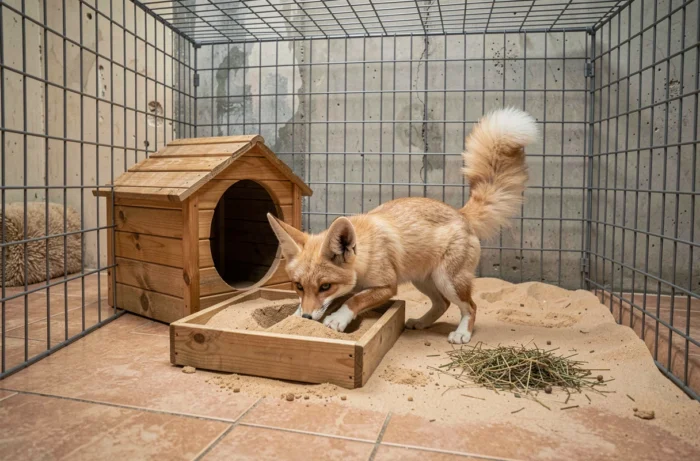
A secure outdoor enclosure remains the best option. The fennec naturally digs burrows: the ground must be deep enough or reinforced to prevent escapes. Indoors, a dedicated room with a sand substrate and hiding places partially reproduces its natural habitat.
Diet
The fennec is omnivorous. Its diet in captivity includes:
- Animal proteins (live insects like crickets, mealworms, sometimes mice for experienced breeders)
- Fresh fruits and vegetables in small quantities, for vitamins and water intake
- Small-sized canine kibble, as a supplement and not as the exclusive base
Hydration comes largely from food, as in its natural environment. A clean water source must, however, remain accessible at all times.
Daily life with a fennec: behavior and limits
The fennec is not a domesticated animal. Thousands of years separate its genetics from that of the dog. This difference translates into daily behaviors that can confuse unprepared owners.
The fennec is very active at night. It digs, jumps, and emits high-pitched vocalizations. In a shared living space, nighttime noise disturbances pose a real neighborly problem. Its liveliness also makes cohabitation tricky with young children or other pets.
Have you ever noticed that a poorly socialized puppy can become fearful? The fennec, on the other hand, retains a permanent flight instinct, even when hand-raised. It does not seek human contact in the same way as a domestic animal. Socialization takes time, patience, and never guarantees a “docile” behavior.
House training presents another challenge. The fennec can learn to use a litter box, but the results remain unpredictable. Its urine has a strong and persistent odor, characteristic of wild canids.
Finding an exotic pet veterinarian and anticipating health costs
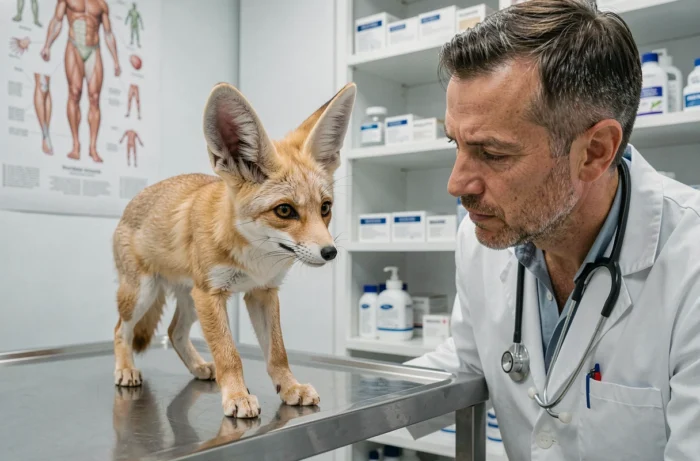
Not all veterinarians take care of fennecs. It is essential to locate a veterinarian specialized in exotic pets (NAC) even before acquiring the animal. These practitioners are concentrated in large urban areas, complicating care in rural zones.
Consultations and care for an exotic animal cost significantly more than for a dog or cat. Common health issues in captive fennecs include:
- Dietary deficiencies (calcium, vitamin D) related to an inadequate diet
- Kidney problems, exacerbated by an overly humid environment or a diet too rich
- Chronic stress, which manifests as self-mutilation or refusal to eat
- Respiratory infections in case of exposure to cold
No standard pet insurance covers the fennec. All veterinary costs are the owner’s responsibility, with no possibility of reimbursement.
Regulatory trends in France: tightening oversight
The French regulatory context is evolving towards increased control of pet animals. A decree that came into effect in August 2026 now penalizes the sale of dogs and cats in pet shops, with fines for establishments that display these animals visible from public roads. This measure directly targets impulsive purchases.
At the European level, a regulation published in 2026 mandates mandatory microchipping for dogs and cats, with interconnected national databases. The fennec is not directly targeted by these texts, but the trend points towards greater traceability for all kept animals.
For a future fennec owner, this tightening means that checks on the origin and conditions of keeping exotic pets will likely intensify. Acquiring a fennec through an unregistered channel becomes riskier each year, both legally and health-wise.
The fennec remains a wild animal whose needs do not match typical domestic life. Those who take the plunge knowingly, with the required authorizations and an appropriate environment, commit to a lifespan that can exceed a decade. The decision deserves to be weighed with the same seriousness as one would give to adopting any other animal.