Among the thousands of cultivable plants in France, those whose names start with K form a small but surprisingly diverse group. What criteria – hardiness, soil type, exposure – truly separate these plants from one another, and which ones deserve a place in a garden subjected to increasingly hot summers?
Hardiness, soil and exposure: comparative table of K plants
Before choosing a flower or tree starting with K, crossing three parameters helps eliminate casting errors. The table below gathers ten common species with their main requirements.
| Species | Type | Hardiness | Soil | Exposure |
|---|---|---|---|---|
| Kalmia latifolia | Shrub | Down to -20 °C | Acidic, heathland soil | Partial shade |
| Kniphofia uvaria | Perennial | -10 to -15 °C | Well-drained, even poor | Full sun |
| Kerria japonica | Shrub | Very hardy | Ordinary | Shade to partial shade |
| Koelreuteria paniculata | Tree | -20 to -25 °C | Drained, tolerates limestone | Full sun |
| Kaki (Diospyros kaki) | Fruit tree | -15 to -18 °C | Deep, moist | Full sun, sheltered |
| Kalanchoë | Indoor plant | Frost-sensitive (0 °C) | Well-draining substrate, pot | Bright light |
| Knautia arvensis | Perennial | Very hardy | Limestone, dry | Full sun |
| Kolkwitzia amabilis | Shrub | Very hardy | Ordinary to limestone | Sun to partial shade |
| Kentranthus (Centranthus ruber) | Perennial | Very hardy | Poor, dry, limestone | Full sun |
| Kalmia angustifolia | Shrub | Very hardy | Acidic, moist | Partial shade |
What stands out is the gap between the soil requirements. On one side, Kalmia strictly requires acidic soil. On the other, Kentranthus thrives in poor, limestone soil. Confusing these profiles condemns the plant from the first season.
To delve deeper into each species with detailed descriptions, a list of flowers and trees starting with K provides a comprehensive overview.
Koelreuteria paniculata and kaki: two K trees facing hot summers
Repeated heatwaves in France change the game for choosing ornamental and fruit trees. Two K species illustrate very different trajectories in this context.
Koelreuteria paniculata, the soap tree of dry gardens
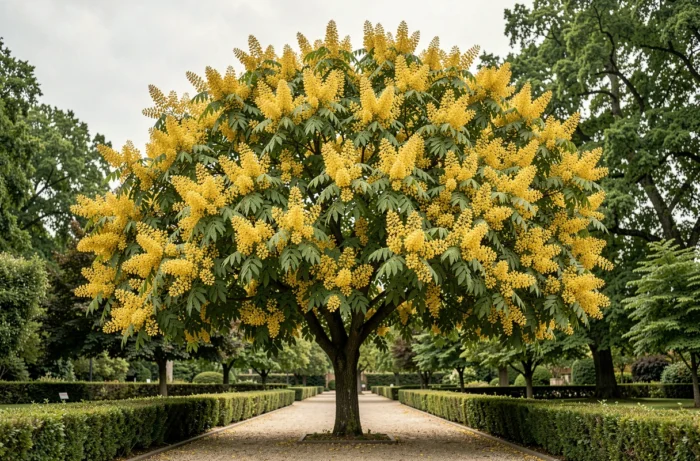
The soap tree is already recognized as a safe bet for dry gardens. With a hardiness rating around -20 to -25 °C, it covers almost the entire French territory. Its yellow summer bloom occurs precisely when few trees are still flowering, giving it marked landscape interest in July-August.
It tolerates limestone, withstands poor soils, and requires virtually no watering once established. For a garden in a suburban area exposed to full sun, it is a more reliable choice than many classic species.
Kaki: a fruit tree exposed to climatic uncertainties
The kaki remains appealing for its sweet orange fruits and autumn foliage. However, the European sector shows increasing vulnerability to extreme weather events. In Spain, in the Valencia region, a hailstorm and heatwave resulted in damages estimated at around 17 million euros in compensation for kaki crops, with nearly 12,000 hectares insured each season.
For an amateur gardener, this data signals a concrete point: the kaki benefits from being planted in a sheltered area from severe hail, protected by a net or windbreak in storm-prone regions. Without this precaution, the fruits and young shoots do not handle sudden episodes well.
Perennial flowers in K: kniphofia, knautia, and kentranthus in the dry garden
Three K perennials share a common point: they thrive in poor, dry, or limestone soils, where many plants decline in summer.
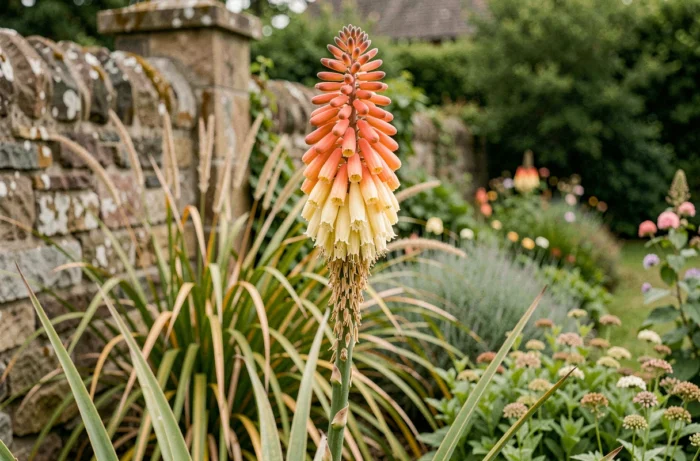
The kniphofia produces flamboyant spikes in full sun if the soil remains well-drained. Its graphic appearance, reminiscent of a torch, adds a verticality absent from classic flowerbeds. The non-negotiable condition: avoid heavy, waterlogged soils in winter, which cause the crown to rot.
Knautia arvensis, or field scabious, blooms for a long time and attracts a massive number of pollinators. It is a discreet perennial that integrates into a wildflower bed without special maintenance. It self-seeds naturally, which can be an advantage or a disadvantage depending on the desired control.
Kentranthus, often called red valerian, colonizes walls, rockeries, and poor soils. Its flowering extends from May to October, a duration that few perennials achieve. Like knautia, it self-seeds abundantly and attracts butterflies.
- Well-drained soil is essential for kniphofia, or it risks winter root rot
- Knautia and kentranthus accept very limestone soils, an asset in chalky terrain
- All three species require little or no watering once established, a decisive criterion during water restrictions
Kalanchoë in pot: long flowering with minimal watering
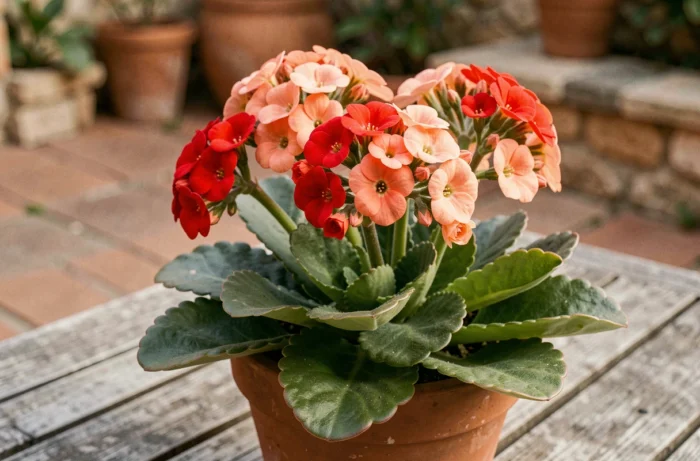
The kalanchoë stands out from all the other plants on this list due to its exclusively indoor use in our latitudes. Frost-sensitive from 0 °C, it does not survive outdoors in winter.
Its flowering can last several weeks with very little watering, making it a logical choice for windowsills or bright rooms. The substrate must remain well-draining: a cactus mix is better than standard potting soil, which retains too much moisture and promotes root rot.
The contrast between the kalanchoë, strictly confined to a pot, and the koelreuteria, capable of withstanding -25 °C in the ground, nicely summarizes the range of K plants. The challenge remains the same: to match the plant’s profile with the actual conditions of the garden, without relying solely on aesthetic appeal.