
A craft business that receives three calls a week when it used to receive ten two years ago, without changing its offer or pricing: the problem rarely lies with the product. It comes from the digital footprint left (or not) on the channels where customers search.
The Afnic 2025 study confirms this erosion: the proportion of French micro and small businesses with a website has dropped from 70% in 2024 to 61% in 2025, and social media presence from 75% to 64%. Working on online visibility has never been more crucial to maintaining a steady flow of customers.
Online Visibility of Micro and Small Businesses: A Setback That Changes the Game
We often talk about web saturation, but the ground reality is harsher. The France Num 2025 barometer shows that social media has become the primary digital contact point for small businesses: 66% have an active account, compared to 65% that have a website. This inversion is recent and has direct consequences on how to build a visibility strategy.
In practice, many leaders create a Facebook or Instagram page even before thinking about a showcase website. The reasoning makes sense: going online is quick, the cost is zero, and initial customer feedback comes in fast. The downside is the dependency on an algorithm that is out of your control. A drop in organic reach on Meta can dry up the flow of contacts within weeks.
Useful resources for structuring this reflection can regularly be found on the cnblog.org site for businesses, which discusses concrete trade-offs between channels based on the size of the organization.
SEO and Content: The Foundation That Withstands Algorithm Changes
Social media provides reactivity. Organic search brings durability. A well-positioned page on a relevant search keyword continues to generate traffic for months, sometimes years, without additional advertising spend.
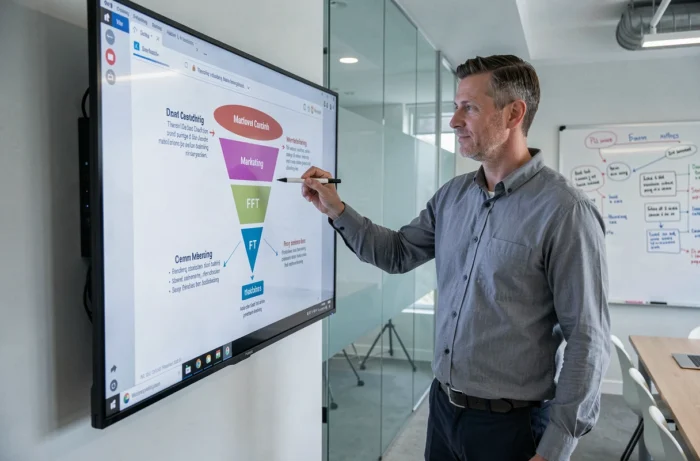
A common pitfall is producing content without direction. A blog post published “just because it needs to be published” is useless if it doesn’t answer a question that your customers are actually typing into Google. The most direct method to identify these questions: open the Google search bar, type the beginning of a query related to your business, and note the automatic suggestions. These suggestions reflect the actual search volume.
Structuring a Realistic Content Calendar
Publishing one article per week is an ambitious goal for a small business that doesn’t have a dedicated writer. Two well-targeted articles per month are better than eight generic articles. Each piece of content should target a specific keyword, address an identifiable search intent, and provide information that the reader won’t find by rephrasing the first line of the SERP.
Feedback varies on this point, but generally speaking, an article of 800 to 1,200 words covering a specific topic performs better than a lengthy 3,000-word guide that skims over ten topics at once.
Optimizing Tags and Technical Structure
Relevant content that is poorly structured remains invisible. The technical elements to systematically check include:
- The title tag of each page must contain the main keyword and remain under 60 characters to display correctly in search results.
- The meta description (between 140 and 155 characters) should entice clicks, not summarize the page.
- H2 and H3 headings organize reading for the user and signal the content hierarchy to search engines.
- The site’s loading speed directly influences ranking: slow hosting or uncompressed images penalize SEO.
AI Search and Brand Visibility: An Emerging Channel to Watch
Search engines now integrate AI-generated answers directly into their results. Google displays AI summaries at the top of the page, and tools like ChatGPT or Perplexity are becoming entry points for discovering brands and services. A business absent from these AI responses loses a growing discovery channel.
The functioning of these systems relies on the ability to identify reliable and structured sources. For an AI to cite your business or content, several practical conditions must be met:
- Fact-based, up-to-date content with verifiable data (prices, features, processes) rather than vague formulations.
- A consistent presence across multiple platforms (website, Google Business profile, social profiles) with identical information everywhere.
- Brand mentions on third-party sites (local press articles, professional directories, partnerships) that enhance perceived credibility by algorithms.
This lever is not reserved for large companies. A craftsman with a complete Google profile, whose website contains detailed FAQ pages, and whose name appears on their chamber of trades’ website is more likely to be cited in an AI response than a competitor with an empty site.

Local Digital Marketing Strategy: Converting Visibility into Customers
Gaining visibility is pointless if the traffic generated does not match your target area. For a business operating locally, local SEO focuses efforts where it produces concrete results. The Google Business Profile remains the most direct tool: it appears in geolocalized search results and on Google Maps, where customers look for a nearby provider.
The most common mistake: creating the profile and then neglecting it. An active profile (recent photos, responses to reviews, up-to-date hours) is favored by the local algorithm compared to a static profile. Customer reviews play a measurable role in ranking: their number, recency, and the quality of responses provided by the business weigh in the positioning.
On social media, the logic is the same. Publishing content rooted in your territory (ongoing construction, local event, collaboration with another neighborhood business) generates more engagement than a generic visual borrowed from a stock image bank.
Online visibility is built in successive layers: a technically solid website, targeted content on your customers’ queries, a well-maintained local presence, and monitoring new channels like AI search. None of these levers work in isolation, but when combined regularly, they produce a flow of contacts that advertising alone cannot replace.