
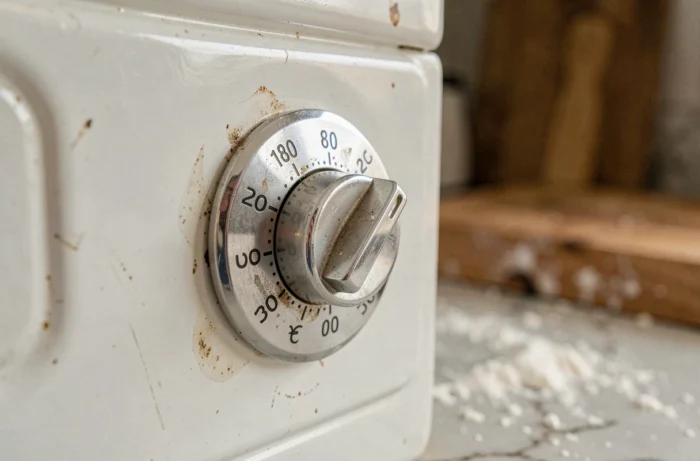
Your recipe indicates 180 °C, but the dial on your oven displays numbers from 1 to 9 without any temperature indication. This discrepancy between degrees Celsius and thermostat settings is the primary source of error in home cooking. The conversion relies on a simple calculation, but a few pitfalls can turn a golden cake into a charred block.
Why your numbered thermostat oven heats differently
Ovens equipped with a numbered selector (1, 2, 3, etc.) use a mechanical thermostat. This bimetallic device cuts off and restores heating around a target temperature. Over time, the bimetallic strip deforms, and the regulation loses accuracy.
Further reading : How to Choose the Ideal SIM Card for Your Doro Senior Phone
An oven set to a position that is supposed to correspond to 200 °C may actually rise to around 215 °C after complete preheating. The opposite is also common: an aging oven that stagnates ten or fifteen degrees below the expected value. This phenomenon affects both gas ovens and electric models.
On recent appliances with a digital display, the electronic probe compensates for these drifts in real time. If you are cooking with a dial oven, the conversion rule remains your starting point, but an independent oven thermometer is the only reliable way to check the actual temperature. You can find them for just a few euros, and the gain in accuracy radically changes the outcome for pastries and roasted meats.
You may also like : Everything You Need to Know to Care for Your Pets
To delve deeper into the equivalence of 150 to 180 degrees in thermostat according to the type of dish, it is useful to cross-reference the calculation rule with the actual behavior of your appliance.
Conversion from degrees Celsius to thermostat: the calculation rule
The principle is based on one operation: divide the temperature in degrees Celsius by 30. Each thermostat level represents an increment of 30 °C.
| Temperature (°C) | Thermostat | Heat Category |
|---|---|---|
| 150 °C | 5 | Medium oven |
| 160 °C | 5-6 | Medium oven |
| 170 °C | 5-6 | Medium oven |
| 180 °C | 6 | Medium oven |
For intermediate values like 160 or 170 °C, the dial does not offer half graduations. The most common solution is to place the selector between positions 5 and 6. On some older gas ovens, the knob allows enough play to set the slider halfway.
Practical case: 150 °C for slow cooking
Thermostat 5. This temperature is suitable for dishes that are simmered in the oven (tagines, vegetable gratins, confits). The moderate heat allows the flavors to concentrate without drying out the food. Expect a cooking time that is longer than at 180 °C, often about double.
Practical case: 180 °C for cakes and roasts
Thermostat 6. This is the most common temperature in French pastry. A pound cake, a fruit cake, a quiche Lorraine: the majority of basic recipes are set at this adjustment. Thermostat 6 is the central reference for oven cooking.
Convection heat and thermostat: should you adjust the setting?
You may have noticed that some recipes specify “180 °C traditional heat” or “160 °C convection heat.” The oven’s ventilation distributes hot air more evenly, which speeds up cooking.
In practice, reduce by 10 to 20 °C compared to traditional heat when switching to convection mode. A cake that requires 180 °C in static mode will cook properly between 160 and 170 °C in convection heat, which means setting the thermostat between 5 and 6 instead of 6.
This correction avoids two common problems:
- A crust that forms too quickly on the surface while the inside remains raw, a typical flaw in cakes and breads
- Drying out of white meats (chicken, turkey) whose surface browns before the center reaches the right temperature
- A pie crust that burns because the heat circulates faster under the dish than in static mode
Check and correct the actual temperature of your oven
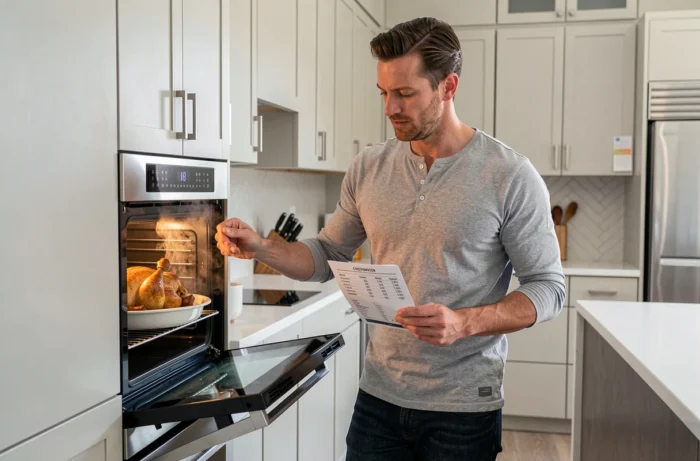
The rule “thermostat multiplied by 30” gives an approximate value, not an exact measurement. Two ovens set to the same position can show several degrees of difference. Here’s how to spot a discrepancy and compensate for it.
The oven thermometer test
Place a dial or probe thermometer in the center of the cavity, on the middle rack. Set the oven to thermostat 6, wait about twenty minutes after the end of preheating, then check the value. If the thermometer indicates significantly more or less than 180 °C, you know which way to correct.
- If the thermometer shows a value higher than the target: lower the selector by a quarter notch
- If the thermometer shows a value lower: raise it by a quarter notch or extend the preheating
- If the difference exceeds thirty degrees: the mechanical thermostat is likely at the end of its life and should be replaced
Safety standards and recent ovens
The European standard EN IEC 60335-2-9:2023+A11:2023, applicable since January 2024, imposes strict limits on the temperature of accessible surfaces of the oven in operation. Ovens compliant with this standard dissipate heat better to the outside, which also improves internal thermal stability. If your appliance dates from before this standard, temperature discrepancies are statistically more frequent.
Knowing the thermostat-degree correspondence is not enough if your oven is off by twenty degrees. The independent thermometer turns an estimate into a measurement, and it is often the only variable that separates a successful cook from a dish that is too dry or not cooked enough. Before looking for a new recipe, first check that your oven lives up to its promises.