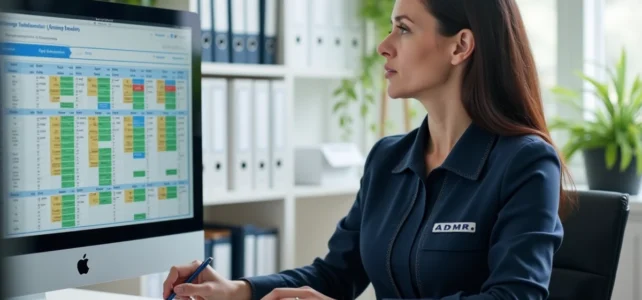
Philia is the management software used by associations in the ADMR network to coordinate home care interventions. It centralizes schedules, beneficiary files, and exchanges between coordinators and field workers. Taking advantage of its features requires understanding its internal logic, particularly how it structures access, data scopes, and planning flows.
Access Rights and File Scopes in Philia
The first step to ensuring a reliable schedule in Philia does not concern the schedule itself, but the configuration of user accounts. A best practices guide recommends limiting each account to a specific file scope, aligned with the geographical area or the type of beneficiaries being followed.
Recommended read : Keys to Successful Project Management in a Modern Environment
In practice, the rights to modify schedules are reserved for coordinators, while field workers have read-only access. This segmentation reduces information noise: each employee only sees the interventions that concern them, which limits reading errors and accidental modifications.
Before touching any time slot, it is essential to verify that the profiles are correctly configured. A scope that is too broad generates confusion, while a scope that is too narrow prevents replacements between sectors. The quarterly review of these rights, in connection with personnel movements, is part of the reflexes to acquire for using the Philia ADMR software for scheduling without accumulating technical debts.
Read also : Discover how to boost your business with essential business tips

Planning Interventions on Philia: Data Entry Logic
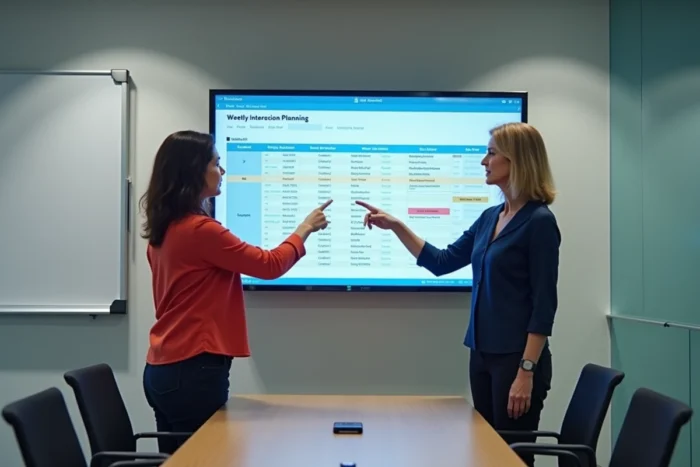
The planning module in Philia operates by intersecting three parameters: the beneficiary, the worker, and the time slot. Each created intervention generates a line visible both in the employee’s schedule and in the beneficiary’s file.
Any modification on one side affects the other. Moving a time slot in a worker’s schedule automatically modifies the calendar of the associated beneficiary. This dual display mechanism is the source of most errors among novice users, who modify a schedule without checking the impact on the beneficiary side.
To plan effectively, the recommended sequence follows a precise order:
- Create or verify the beneficiary’s file (contact details, type of service, contractual hourly volume) before assigning any time slot
- Assign the worker based on their skills and geographical area, taking into account travel times between two homes
- Validate the time slot only after ensuring it does not create an overlap with another intervention already scheduled for the same employee
Overlap detection exists in Philia, but it is not blocking by default. The software displays a visual warning that the coordinator can ignore. This flexibility, designed to manage special cases, becomes a trap if one clicks too quickly.
The Daily Log as a Tool for Tracking Completed Schedules
The digital daily log in Philia records the report of each intervention: arrival time, departure time, tasks performed, and any observations. It serves as the link between the theoretical schedule and the schedule actually executed.
A recurring discrepancy between scheduled hours and hours recorded in the daily log indicates a sizing problem. Either the allocated time is insufficient for the service, or travel times between beneficiaries are underestimated. The coordinator who regularly consults these discrepancies has a concrete lever to adjust future schedules.
Philia Internal Messaging and Field Coordination
Philia integrates a secure messaging system that allows coordinators to communicate with workers without using personal channels (SMS, third-party applications). The benefit for schedule management is direct: a last-minute change (cancellation of a beneficiary, replacement of an absent colleague) is transmitted through a traceable and time-stamped channel.
The Philia messaging system is not just a convenience tool. It ensures that the scheduling information reaches the concerned worker and that receipt is recorded. In case of a dispute over a missed intervention, the coordinator can check if the message has been read.
For this circuit to function, workers must have operational mobile access. The platform is accessible via a browser on smartphones, which requires a stable internet connection during rounds. In rural areas where the ADMR network has historically been established, this technical constraint remains a point of vigilance.
Common Scheduling Errors and Philia Configuration
Several errors systematically recur in organizations that deploy Philia without thorough training. Identifying them allows for anticipation.
- Creating recurring interventions without an end date, which generates ghost schedules over several months and skews hour counters
- Forgetting to update the beneficiary’s file after a change in situation (hospitalization, relocation), which keeps active slots for suspended services
- Granting modification rights to all users for convenience, which multiplies the risks of accidental deletion or movement of interventions
- Neglecting to enter data in the daily log, making any analysis of discrepancies between planned and executed impossible
The majority of these errors stem from initial configuration, not from a defect in the software. A rigorous setup in advance, combined with periodic reviews of rights and active files, significantly reduces the volume of anomalies to be addressed daily.
The Growing Role of the Philia Planner Position
Some ADMR associations have formalized a position dedicated to planning on Philia. An offer published on France Travail describes an administrative management assistant whose main mission is to plan interventions via the software, including configuring workers’ phones, managing dashboards, and monitoring contracts.
This professionalization reflects a simple observation: managing schedules on Philia requires enough technical skills and time to justify a full-fledged role, distinct from field coordination.
The Philia software is not just a shared calendar. Its value depends almost entirely on the rigor with which accounts are configured, files are kept up to date, and field data is utilized. A reliable schedule in Philia is the result of collective discipline, not an isolated feature.