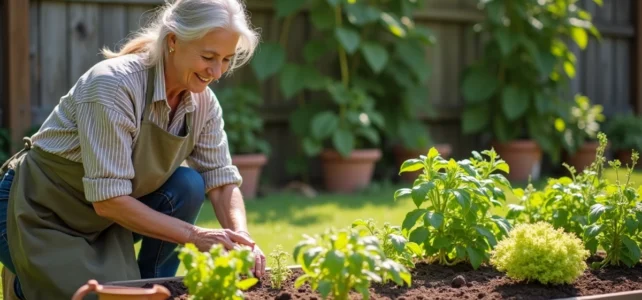
A productive vegetable garden year-round relies less on the choice of vegetables than on managing transitions between beds. Each bed freed after harvest must be reoccupied within two weeks; otherwise, the soil compacts, weeds take over, and the next sowing window closes. Here, we detail the technical levers that make the difference between a seasonal vegetable garden and one in continuous production.
Sequential planting: the true engine of a productive vegetable garden all year round
Most guides present year-round cultivation as a question of timing. The issue lies upstream: it is the speed of rotation on each bed that determines overall yield. A bed of beans harvested at the end of July must receive its autumn sowings (lamb’s lettuce, spinach, chicory) immediately afterward, ideally after a simple superficial raking.
You may also like : All the latest motorcycle news: reviews, new releases, and practical tips for enthusiasts
Leaving the soil bare, even for a few weeks, disrupts the biological dynamics of the soil. If you cannot sow immediately, cover with a short-cycle green manure (mustard, phacelia) that will be mowed and incorporated before sowing the next crop. Each freed bed must be reoccupied or covered within fifteen days.
We recommend keeping a simple table for each bed: harvest date, planned next crop, sowing date. This tracking avoids production gaps that turn a four-season vegetable garden into a summer garden with a few autumn salads.
Further reading : Everything You Need to Know About Declaring Your Terrace for Taxes: Steps and Practical Tips
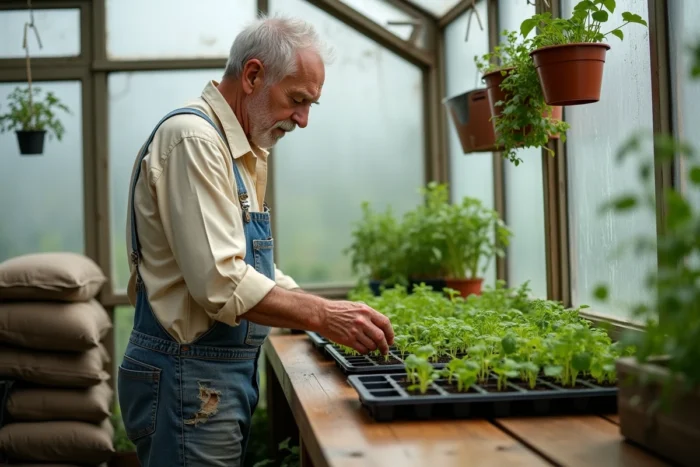
Tracking sheets by bed and season are available at lejardineur.net, which facilitates planning successions without leaving bare soil between two crops.
Vegetable garden and heatwave: create a microclimate rather than endure the heat
The classic reflex in the face of high temperatures is limited to mulching and morning watering. These two actions remain necessary but are no longer sufficient when heatwaves last for several weeks. A resilient vegetable garden combines light shading, thick mulching, and deep watering at the base.
Shading can take several forms depending on the garden’s layout:
- Woven shade cloth (not plastic tarps) stretched to a good height above the most exposed beds, removed as soon as temperatures drop.
- Support crops: pole beans, corn, or sunflowers planted along the southern edge to filter direct sunlight on salads and delicate seedlings.
- Trellis or permanent plant screens that create a cool corridor without blocking natural ventilation.
During a heatwave, we observe that it is better not to sow or transplant. Young plants experience immediate water stress, and the survival rate drops. Wait for milder temperatures to install your autumn crops, even if it delays the schedule by a few days.
Non-breathable tarps should be avoided: they trap moisture and heat beneath the surface, promote fungal diseases, and can literally cook the shallow roots.
Winter sowing in the vegetable garden: prepare in summer to harvest until March
Winter crops are decided in the middle of summer. It may seem counterintuitive, but chicory, winter cabbage, lamb’s lettuce, and spinach are sown between July and September depending on the region. Waiting until October to think about it means losing half of the winter potential.
Chicory (sugar loaf, red chicory type Treviso) tolerates cold well and provides leaves until February under a simple forcing cover. Winter salads (lamb’s lettuce, arugula) take up little space and require well-drained soil. Spinach sown at the end of August produces staggered harvests from October to March if you pick leaf by leaf rather than uprooting the plant.
For heavy soils that become waterlogged in autumn, growing on slightly raised beds improves winter drainage and limits collar rot. A few centimeters of elevation is sufficient in most cases.
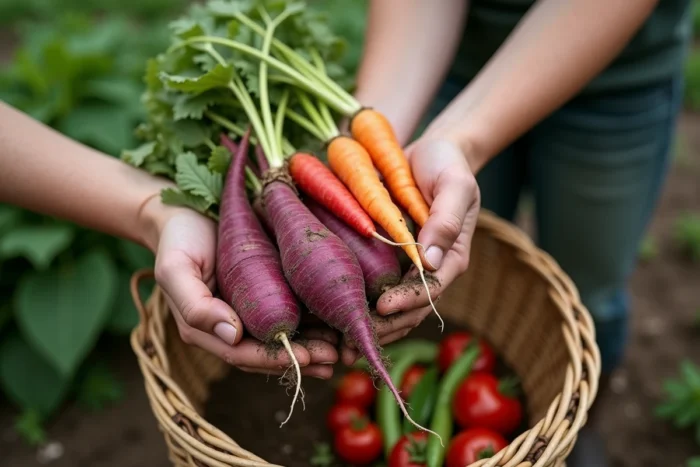
Container and raised bed gardening: specific constraints on water and soil
Raised beds and containers dry out much faster than a bed in the ground. The limited volume of substrate offers little water reserve, necessitating more frequent watering in summer, sometimes daily.
Beyond water, the substrate itself degrades. After two or three seasons, the potting soil compacts, loses its structure, and its nutrients. Renewing at least one-third of the substrate each autumn maintains a favorable environment for roots. Mix mature compost with the remaining potting soil, then lightly rake before sowing your winter crops.
In containers, crop rotation remains crucial. Alternating botanical families (nightshades, cucurbits, legumes, alliums) from one season to the next limits the accumulation of specific pathogens in a restricted volume of soil.
Living soil and fertility in the vegetable garden: what rotation alone does not solve
Rotation prevents targeted depletion of the soil by the same plant family. It does not compensate for biologically poor soil. We recommend coupling rotation with an annual addition of organic matter (compost, composted manure) and maintaining permanent soil cover.
Organic mulching (dead leaves, straw, chipped branches) serves a dual purpose: it protects soil life in winter and decomposes slowly to nourish subsequent crops. A permanently covered soil remains fertile longer than a worked soil left bare.
On beds awaiting sowing, a green manure sown between two crops (clover, vetch, rye) fixes atmospheric nitrogen and structures the soil deeply. Mow it and incorporate it superficially two to three weeks before the next sowing to allow time for decomposition to begin.
A vegetable garden that produces year-round does not require more space than a traditional garden. It mainly demands tight planning of successions, attention to the microclimate of each bed, and a soil that is nourished as much as it is utilized. The rest is observation over the weeks.