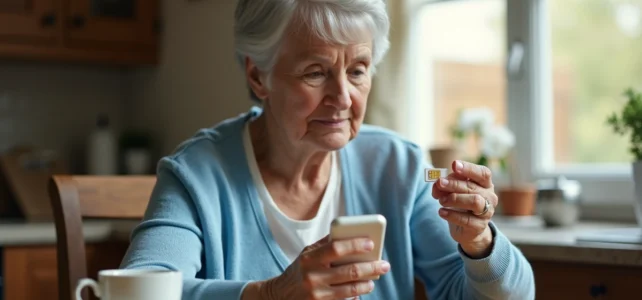
Not all Doro phones accept the same SIM card format, and recent models impose constraints that older ones did not have. Before comparing plans, the first piece of information to check is the physical format required by the device, followed by network compatibility (2G, 3G, 4G). These two technical parameters determine whether a SIM card will work in a Doro senior phone or not.
Nano SIM format on recent Doro models: the triple cut trap
The latest Doro models (Leva E10, Leva E10s, Leva E20) exclusively require a nano SIM card in 4FF format. The user manual for the Doro Leva E10s explicitly states: the device only accepts this format, and using a card of a different size, even if manually cut, can damage the internal connector and corrupt the data.
See also : How to Convert 150 to 180 Degrees on Your Thermostat for Perfect Oven Dishes
The triple-cut cards sold by most operators seem to solve this problem. In practice, the detachment of the smallest template sometimes leaves plastic burrs on the edges. These micro-irregularities are enough to block insertion into the SIM drawer of a Doro or create a false contact.
To determine which SIM card to choose for Doro, the most reliable approach is to order a nano SIM directly from the operator rather than cutting an existing card. Older models (Doro 6060, Doro 6040) still work with micro SIMs, which adds to the confusion when changing phones within the same brand.
Recommended read : How to Easily Obtain Your Pajemploi Siret Number for Home Employment

4G network compatibility and senior plans: comparison table
Recent Doro models are compatible with 2G, 3G, and 4G. With the gradual shutdown of the 3G network by some operators, a plan including 4G has become a necessity, not a luxury. Here is a comparison of the types of offers available based on their technical characteristics and their suitability for Doro phones.
| Type of plan | SIM format provided | Supported network | Activation PIN code | Commitment |
|---|---|---|---|---|
| Specialized senior plan (e.g., Mobiho Essentiel) | Triple cut (nano included) | 2G / 3G / 4G | SIM delivered without PIN code | No commitment |
| Classic plan from major operators | Triple cut | 2G / 3G / 4G / 5G | Active PIN code by default | Variable (12 or 24 months) |
| Blocked / prepaid plan | Variable by operator | 2G / 3G / 4G | Active PIN code | No commitment |
Specialized senior plans stand out on one rarely mentioned point: the SIM arrives pre-activated and without a PIN code. The first month is already credited, and an accompanying letter explains how to get started. For a senior user who is not very familiar with entering codes, this difference significantly simplifies the setup.
Blocked plan or classic plan for a Doro
A blocked plan prevents any excess consumption. The user is not at risk of unexpected bills related to unintentional internet connections or premium SMS. On a Doro feature phone, where web browsing remains limited, a blocked plan covers the majority of actual usage: calls, SMS, and possibly MMS.
In contrast, a classic plan with included data makes sense on Doro devices running Android (Doro 8100 and equivalents). These models allow the installation of applications, viewing photos sent by family, or using WhatsApp. In this case, plan for at least a few hundred megabytes of mobile data per month.
Voicemail and APN configuration: two settings that often block
Inserting the SIM card does not always make the phone fully functional. Two settings regularly cause problems on Doro devices.
- Voicemail sometimes requires manual activation via an operator code (often 888 or 123 depending on the network). On some Doro devices, the call shortcut to voicemail is not configured by default and must be entered in the phone settings.
- The APN (Access Point Name) conditions access to the internet and MMS. Doro devices running Android usually configure it automatically upon SIM detection. Doro feature phones under proprietary systems sometimes require manual entry of APN settings, available on the operator’s website.
- The PIN code, when active, must be entered at each power-up. Some senior operators disable it by default, which avoids a lockout after three incorrect entries, a common situation for users who do not easily remember a four-digit code.

Micro SIM or nano SIM Doro: check before changing phones
Switching from an old Doro (micro SIM) to a recent model (nano SIM) involves requesting a card replacement from the operator. This operation is free with most providers, but it takes a few days. During this time, the old phone will not work with the deactivated SIM.
Anticipating this change before purchasing the new Doro avoids a period without a phone. Ordering the replacement nano SIM in advance allows for the exchange on the day of receipt of the device.
SIM adapters (nano to micro) exist, but their use is not recommended by Doro. A poorly positioned adapter can get stuck in the SIM drawer and require a visit to customer service. For a device aimed at simplicity, this risk is not justified.
The choice of a SIM card for a Doro phone therefore relies on two prior checks: the exact physical format of the concerned model and the 4G network compatibility of the plan. Once these two points are validated, the most discriminating criterion remains the ease of setup, where pre-activated senior plans without a PIN code offer a concrete advantage over mainstream offers.