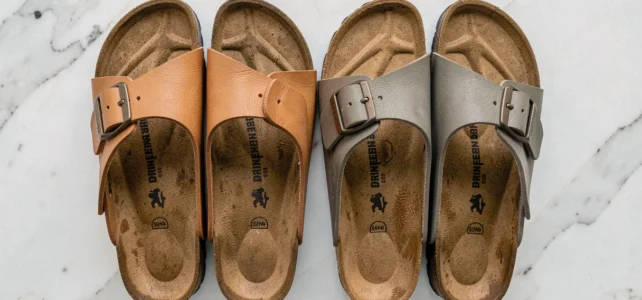
Birkenstocks are among the most copied shoes in the world. The problem is not limited to crude counterfeits sold in informal markets: some fake pairs faithfully reproduce the logo, buckles, and even the original packaging. Distinguishing a real Birkenstock from an imitation relies on precise technical details, focused on the sole, materials, and internal markings.
Dupe, counterfeit, and refurbished pair: three distinct realities in the resale market
Authentication guides focus on the “real or fake” dichotomy, but the second-hand market blurs this boundary. Three categories circulate, and confusing them exposes buyers to different purchasing errors.
You may also like : How to Organize a Festival Committee: Key Steps and Tips for Success
A Birkenstock dupe is a legal product. Another brand makes a sandal that takes on the general aesthetic (cork sole, adjustable straps) without bearing the name Birkenstock. The dupe does not claim to be a Birkenstock. Its quality varies, but it is not considered a counterfeit.
A counterfeit reproduces the brand and logos to pass itself off as an authentic product. This is a crime. Birkenstock has intensified its litigation strategy against imitators, increasing lawsuits for copyright infringement to contain this phenomenon.
See also : Discover how to navigate easily with a well-structured sitemap
The third category is the least documented: the authentic but refurbished pair. On platforms like Vinted or eBay, some sellers offer used Birkenstocks whose insoles have been replaced with a generic footbed, or whose straps have been changed. The pair is partially real, but its authentication elements have disappeared or been altered. To delve deeper into these distinctions, it is useful to know how to recognize a Birkenstock counterfeit on Caro Bleue Violette before any second-hand purchase.
Birkenstock anatomical footbed: the most reliable checkpoint
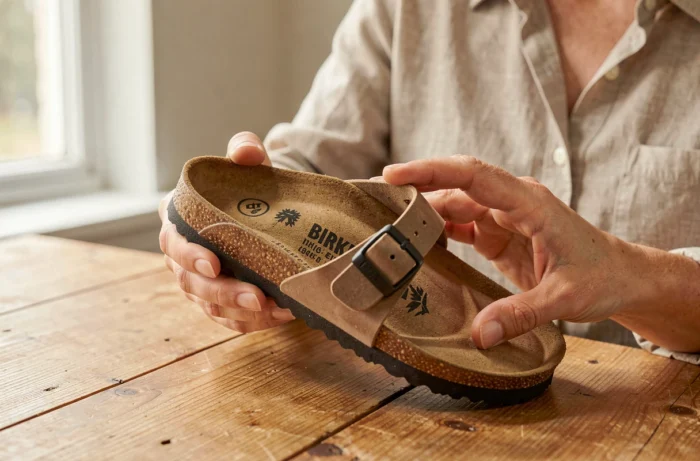
The insole (footbed) is the most difficult element to reproduce for counterfeiters. On a real Birkenstock, it features a relief anatomical imprint representing a foot skeleton. This marking is molded into the material, not just printed on the surface.
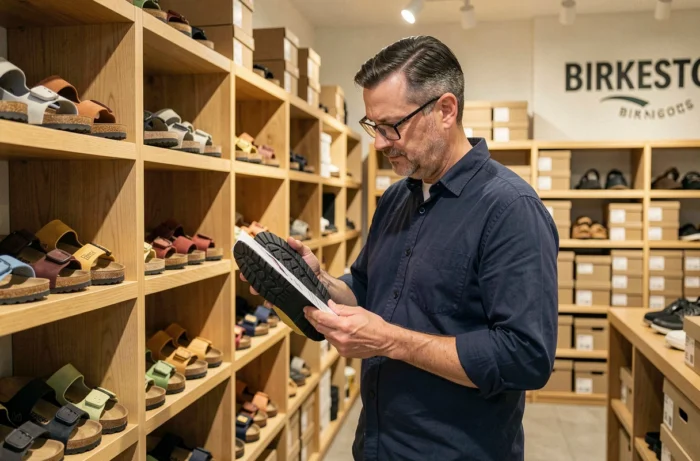
When flipping the shoe over, the outsole must bear the name Birkenstock engraved in the rubber. On counterfeits, this engraving is often too shallow, poorly centered, or in a slightly different typography.
What the footbed reveals to the touch
The cork of an authentic Birkenstock has a regular grainy texture. Counterfeits frequently use a foam mixture covered with a thin layer imitating cork. After a few days of wear, this layer peels off or compresses unevenly, while a real Birkenstock footbed retains its shape.
The suede layer covering the footbed on classic models (Arizona, Boston) is another indicator. On an authentic pair, this covering is soft yet durable. On a copy, it wears out very quickly and takes on a shiny appearance.
Logo and buckles: markings to check on authentic Birkenstocks
The name Birkenstock must appear in three distinct places on each pair:
- On the metal buckles, the word “Birkenstock” is engraved or stamped in relief. On fake pairs, the lettering is often raised, blurry, or slightly misaligned with the center of the buckle.
- On the inner side of the sole (foot side), the complete logo with the brand name and model is printed. This print is sharp and withstands the first days of wear.
- On the outsole, the name is molded into the rubber with uniform depth.
The absence of marking on any of these three points indicates a counterfeit. The most careful copies reproduce the logo on the buckles but neglect the outsole, or vice versa.
Typographic details to watch for
The font used by Birkenstock is consistent from one model to another. The letters have specific proportions, and the final “K” has a characteristic serif. On counterfeits, the font is often approximate: irregular spacing between letters, varying stroke thickness, or an “R” with a leg that is too short.
Buying second-hand Birkenstocks: specific checks for resale platforms
The second-hand market for Birkenstocks is active, especially for leather Boston models whose new prices have risen. Buying second-hand requires additional checks compared to a purchase in-store.
Some platforms like eBay have implemented multi-point authentication programs for specific categories, with cross-checking of labels, logos, soles, product codes, and mandatory photos. This trend reflects the rising concerns about counterfeits in the resale market.
On platforms without integrated authentication (Vinted, Leboncoin), several signals should raise alarms:
- A price significantly lower than the second-hand market for the specific model, especially for leather Boston or Arizona
- Blurry or cropped photos that do not show the buckles, outsole, or footbed in detail
- The absence of a photo of the inner label with the article number and size
- A seller offering multiple sizes of the same “new in packaging” model: this is a typical signal of counterfeit stock
For worn second-hand pairs, check that the wear on the footbed corresponds to a real foot imprint. An authentic Birkenstock worn for several months shows a visible depression at the pressure points of the heel and forefoot. A counterfeit worn for the same duration presents a more uniform compression, as the internal foam does not react like cork.
The last point concerns refurbished pairs: if the insole looks new on a pair whose straps show signs of wear, the footbed has likely been replaced. This replacement is not fraudulent in itself, but it removes the original markings and makes authentication by the sole impossible. In this case, rely on the buckles and outsole as remaining checkpoints.