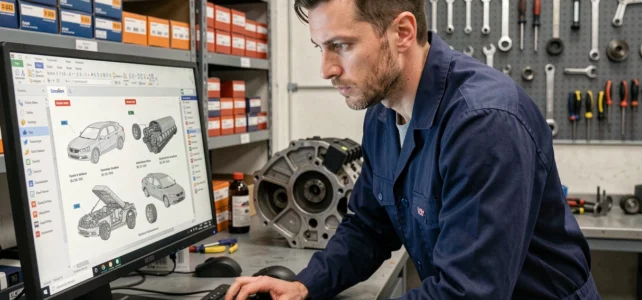
Dialogys is the software that Renault provides to access its spare parts catalog and technical documentation. Since the transition to the online version (New Dialogys), searching for a part reference goes through a web portal linked to the manufacturer’s ASOS ecosystem. The operation of this tool, its access constraints, and its concrete limitations deserve to be detailed to understand what it truly offers compared to market alternatives.
Browser, access rights, and ASOS portal: the prerequisites that no one tests before blocking
Even before searching for a part, the first difficulty with New Dialogys is technical. The platform operates in a browser, but users report loading issues with outdated browsers or certain active extensions, particularly for interactive electrical diagrams.
See also : How to Easily Find Classified Ads Near You in Just a Few Clicks
Access itself depends on the ASOS portal. Field feedback indicates that activating account rights can block access if the garage administrator has not validated the user profile. This administrative step adds a delay that Dialogys competitors do not mention.
Specifically, an independent mechanic looking to find a part with Dialogys Renault must first ensure that their ASOS account is active, that their browser is up to date, and that ad-blocking extensions are disabled. Without these checks, the platform may refuse to display catalogs or load incomplete pages.
See also : Discover how to navigate easily with a well-structured sitemap

Searching by VIN in Dialogys: what the serial number unlocks
The most reliable method for identifying a part in New Dialogys remains the search by VIN (Vehicle Identification Number). Entering this 17-character code allows the platform to automatically filter compatible references based on the engine type, trim, and year of the vehicle.
This approach reduces order errors related to variations of the same model. For a Clio or a Scénic, for example, differences in engine types between two closely related generations can involve completely different engine mounts or wiring harnesses. The VIN removes the ambiguity that the mere brand/model selection cannot resolve.
Cross-referencing the part reference with technical documentation
The scope of Dialogys goes beyond just a parts catalog. The tool integrates repair procedures, electrical diagrams, and manufacturer methods. This cross-referencing between the part reference and the associated documentation allows verification, before ordering, if the replacement requires specific tools or an electronic reset procedure.
For a professional in the workshop, this feature avoids a costly back-and-forth: ordering the part, discovering during installation that a calibration tool is needed, and then postponing the intervention. Dialogys links the part reference to its installation method, distinguishing it from general online catalogs.
Old downloadable Dialogys and recent vehicles: an incompatibility to be aware of
The old version of Dialogys, which can be installed locally, has stopped being updated. The last known downloadable version dates back to late 2019. This frozen database poses a direct problem: it does not correctly reference vehicles marketed after this date.
A user searching for a part for a recent vehicle on this old version risks encountering an incorrect reference or even the complete absence of the model in the database. Field feedback varies on this point, with some garages having retained the old software for vehicles prior to 2020 while using New Dialogys for the rest.
- Vehicles prior to 2019: the old Dialogys can still provide usable references, provided it is cross-referenced with the online catalog to verify parts updates
- Vehicles after 2019: only New Dialogys online has the data updated by the manufacturer
- Dacia and Alpine vehicles: these brands are covered by the same New Dialogys platform, centralizing the search for multi-brand workshops in the group
Dialogys vs independent parts catalogs: where the limit lies
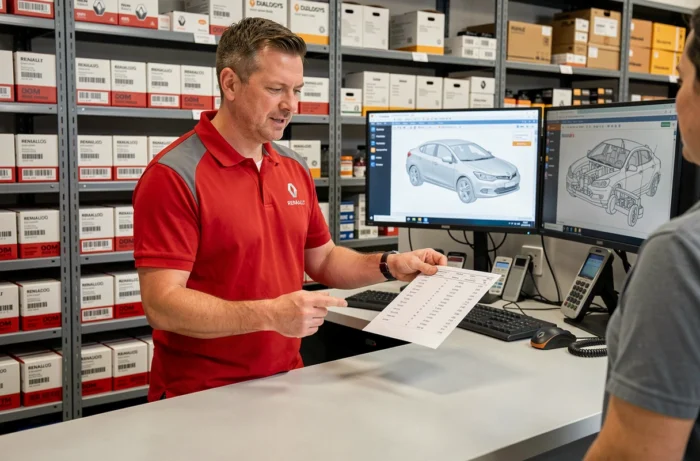
Third-party platforms also offer catalogs of Renault spare parts, with filters by registration or model. Their main advantage is access without ASOS subscription or administrator account validation.
However, these independent catalogs generally do not provide access to manufacturer repair procedures or electrical diagrams. They identify the part, but not the replacement method. For an oil filter or brake pads, the difference is marginal. For an ADAS sensor or an engine control unit, the lack of technical documentation can turn a simple operation into a risky intervention.
The issue of database updates
Independent catalogs depend on databases that are not always synchronized with manufacturer updates. When Renault modifies a part reference during production (which happens regularly on high-volume models), the delay in reflecting this in third-party databases can vary from a few weeks to several months.
Dialogys, fed directly by Renault, reflects these changes more quickly. For workshops handling a regular volume of recent vehicles, this responsiveness justifies going through the ASOS portal despite its administrative constraints.
- Independent catalogs: free access, quick search, but absent technical documentation and delayed updates
- New Dialogys: access conditioned by ASOS, VIN search, integrated technical documentation, and database updated by the manufacturer
- Old local Dialogys: usable for vehicles before 2020, but frozen and without support
The choice between these tools depends on the type of intervention and the age of the vehicle. For a common wear part on a well-documented model, a third-party catalog is often sufficient. For an intervention on a recent electronic system, going through Dialogys remains the safest method to obtain the correct reference associated with the correct procedure.