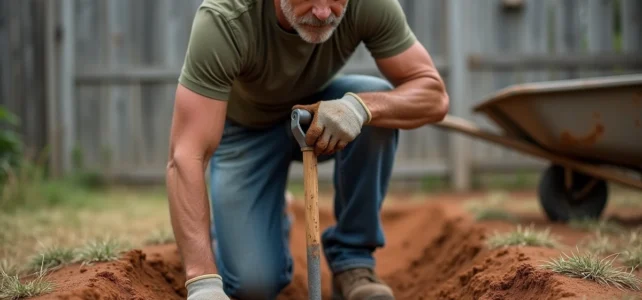
A compacted soil due to trampling, the passage of machinery, or simply years without work forms a dense crust that repels water and breaks tools. Before choosing a tool or method to dig in hard soil, it’s essential to understand what makes this soil so difficult to penetrate and why most common approaches waste energy.
Several recent approaches, derived from market gardening and ergonomic tool design, change the way to tackle the problem. They share one principle: work with the soil structure rather than against it.
Recommended read : LMNP status explained: benefits, taxation, and tips for a smooth investment
Crust formation and compaction: what really blocks the shovel
Hard soil is not a homogeneous block. On the surface, a crust of a few centimeters forms when fine particles clog the soil’s pores due to rain or watering. Below, the actual compaction results from repeated mechanical pressure.
This distinction matters because the two layers are treated differently. Sometimes, breaking the surface crust is enough to make the soil penetrable, without needing to turn the earth deeply. French market gardeners are experimenting with superficial crust-breaking tools (like the Fairtill) that only crack the top few centimeters to allow water and air to penetrate.
Related reading : Understanding the Differences Between Administrative Circulars and Instructions: A Practical Guide for Professionals
In garden soil, the technique translates with a pointed tool (pickaxe, spike, or even a simple crowbar): fracturing the crust two to three centimeters before digging significantly reduces resistance. The rest of the soil, less compacted, gives way more easily.
For those looking to dig a hole in hard soil methodically, this preparatory step saves considerable time compared to a direct attack with a spade.
Moistening hard soil before digging: method and limits
Water is the most commonly cited lever for softening hard soil. The principle works, but its effectiveness depends on two parameters that most guides overlook: penetration time and the actual amount absorbed.
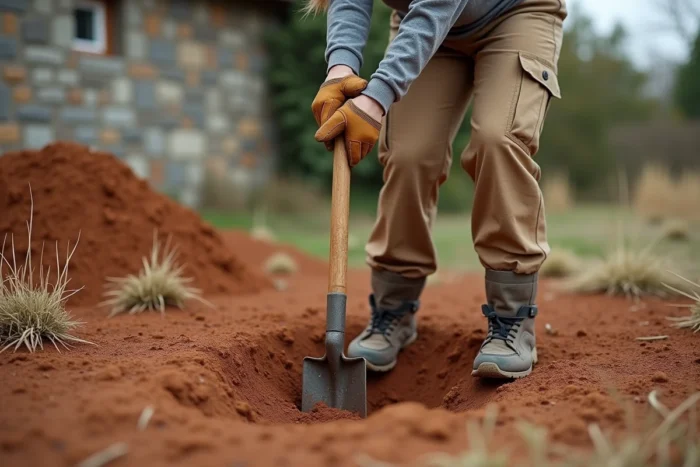
On very compacted soil, watering the surface is almost useless. Water runs off, and the crust repels it. First, this crust must be cracked (see the previous section), then allow the water to infiltrate slowly. Watering the day before the work, at the end of the day, allows several hours of nighttime penetration without evaporation.
What moistening does not solve
Waterlogged clay soil becomes sticky and heavy. It sticks to the shovel, weighs down each scoop, and makes extraction more difficult, not less. Optimal moisture is between dry soil and saturated soil: the earth should be easy to penetrate without sticking to the tool.
In compact sandy soil, water facilitates work almost immediately. In clay soil, excessive watering complicates the task. The nature of the terrain determines the amount of useful water, and no universal rule applies.
Ergonomic tools for hard soil: beyond the spade
In recent years, gardening tool manufacturers have offered spades and forks with fiberglass handles, “D” grips, and anti-vibration systems. These designs aim to reduce musculoskeletal disorders related to digging in hard soil.
The choice of tool depends less on the brand than on the suitability between the tool’s shape and the type of hole intended:
- The pickaxe (or spike) attacks compacted soil by percussion. It fragments without lifting, preparing the ground for an extraction tool. On hard soil, it is the primary striking tool.
- The manual (or mechanical) auger drills a clean cylindrical hole, suitable for fence posts or tree planting. It penetrates the compacted layer by rotation, requiring less effort than a lever movement.
- The hand fork, narrower and longer than the spade, penetrates heavy soils with a reduced attack surface. The pressure per square centimeter is greater for the same effort.
A bent or ergonomic handle does not replace the right tool: using a wide spade on hard soil multiplies unnecessary effort. Reducing the contact surface remains the most effective mechanical principle.
No-dig approach applied to spot holes
The “no-dig” method is based on a simple observation: forcing compact soil to open is not always the best strategy. By covering the surface with compost and mulch for several months, the biological life of the soil (earthworms, microorganisms) naturally decompacts the upper layers.
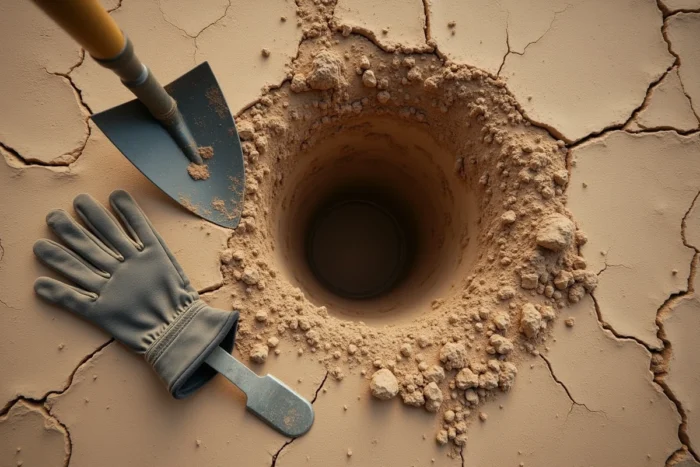
For a spot hole (planting a shrub, installing a post), this logic translates. Instead of digging a large hole in stubborn hard soil, some gardeners prepare the area several weeks in advance:
- Cover the location with a thick layer of compost or organic mulch to attract biological activity
- Crack the surface crust with a pickaxe, then lightly water to accelerate penetration
- Dig the hole a few weeks later, when the soil structure has begun to change at the surface
This approach requires foresight. It is not suitable for urgent work, but it significantly reduces digging effort in the medium term. Over the seasons, the treated areas become increasingly easier to work.
When this method does not work
Deeply compacted soil (beyond the zone of biological activity, usually the top few centimeters) will not be affected by surface compost. For a deep hole, the pickaxe or auger remains essential. No-dig prepares the upper layer, not the subsoil.
Work sequence for a clean hole in hard soil
Rather than a list of tools to buy, reducing effort involves a logical sequence. First, crack the crust (pickaxe or spike), moisten without saturating, then extract with a narrow tool (hand fork or auger) while working in successive layers of thin thickness. Each step facilitates the next.
The usual reflex (sticking the spade into dry soil and forcing) is the most energy-consuming scenario. Preparing the soil before attacking it divides the effort by a factor that no single tool can compensate for.