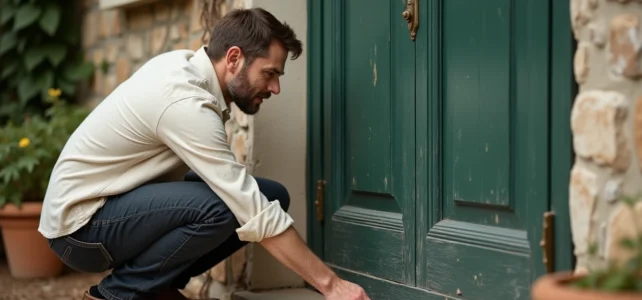
Every summer, the same scene repeats itself in thousands of homes: a door that barely stuck in June becomes impossible to close in July. The phenomenon affects wood, PVC, and, to a lesser extent, aluminum.
Thermal expansion and variations in humidity change the dimensions of the door leaf and frame by a few tenths of a millimeter, enough to block closure or put pressure on the lock. Understanding the mechanism allows for early action, before the problem worsens during a heatwave.
Read also : Everything You Need to Know to Care for Your Pets
Anticipate in spring: adjustments and preventive maintenance of doors
Most content addresses the issue once the blockage has occurred. However, the most effective lever is upstream, between March and May, when temperatures rise without yet reaching summer peaks.
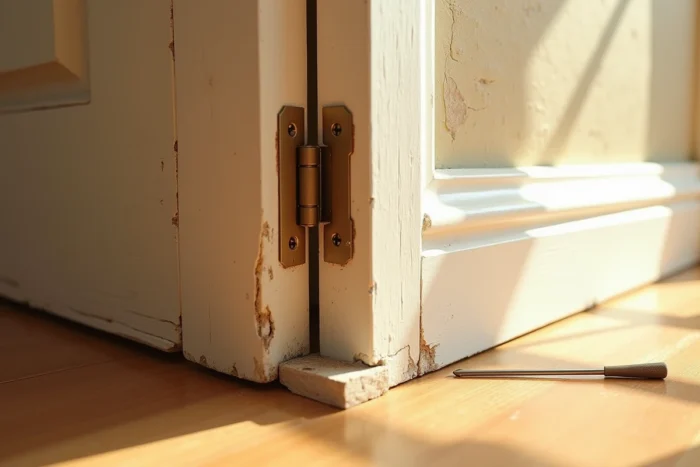
Recent joinery (PVC, aluminum, wood with modern hardware) includes multi-axis adjustment screws accessible with an Allen key. Three axes are generally available: height, lateral, and compression against the frame. A quarter turn adjustment on the compression axis in spring is often enough to restore the necessary play to absorb summer expansion.
Further reading : Discover how to boost your business with essential business tips
On a wooden door, spring is also the time to check the condition of the stain or varnish. An intact protective film limits moisture exchange between the wood and the surrounding air, thus reducing swelling. If the finish is flaking, light sanding followed by a new coat significantly reduces future deformations.
When a door that closes poorly due to heat becomes a recurring problem each year, it often indicates that this preventive maintenance has been neglected for several seasons in a row.
Managing indoor humidity on a daily basis
Heat alone does not explain everything. It is the combination of temperature and humidity that causes wood to swell. Recent technical guides converge on one point: the management of openings directly conditions the deformations of joinery. Ventilating early in the morning and late in the evening, then closing doors and windows during the day, stabilizes indoor humidity and limits dimensional variations in wood.
This habit costs nothing and serves as the first line of defense against summer door swelling.

Diagnosis of a blocked door in summer: lock or deformation of the leaf
When the door is already sticking, the temptation is to force it. This is the worst possible reaction, both for the key and for the cylinder. Before any intervention, a simple test can help locate the problem.
Open the door and test the lock without any load. If the key turns normally with the door open, the mechanism is functioning: the problem lies in the alignment between the leaf and the frame, or between the bolt and the strike plate. If the key also sticks with the door open, it is the cylinder or the lock itself that is problematic, regardless of the heat.
In the case of deformation: effective actions
In the majority of summer situations, it is the leaf that has swollen. Here are the interventions to consider in order of priority:
- Adjust the hinges using the compression screws to slightly move the leaf away from the frame, without disassembling anything.
- Lubricate the strike plate and the bolt with a dry lubricant (graphite or silicone), never grease which attracts dust and worsens the blockage over time.
- Identify friction areas by sliding a piece of paper between the leaf and the frame, then sand locally with fine grit (180 to 220) only if the hinge adjustment is not sufficient.
In the case of the lock: when the mechanism is at fault
On a multi-point lock, heat can misalign the rollers or auxiliary bolts with their respective strikes. Adjustment then involves the strikes themselves, which often have a slight positioning play. Loosen, reposition, tighten: the operation requires patience, not special skills.
However, if the cylinder squeaks or if the key is difficult to insert even with the door open, replacing the cylinder is preferable. Forcing a cylinder weakened by heat and wear can lead to a broken key in the lock, turning a minor issue into a locksmith emergency.
The trap of planing during a heatwave
Planing a door that sticks in July is a common reflex. It is also the most costly mistake in the long term. Wood that has swollen due to heat and humidity will contract in autumn and winter. Planing calibrated to summer dimensions creates excessive play for the rest of the year, leading to drafts, loss of sound and thermal insulation, and sometimes a leaf that no longer fits in its frame.
Joinery professionals recommend never permanently correcting a door without checking its behavior during the mid-season, typically in April or October, when conditions are average. While light sanding is acceptable in summer to resolve an urgent situation, any planing greater than one millimeter should wait until mid-season.
PVC and aluminum doors facing high temperatures
Wood does not have a monopoly on summer problems. PVC deforms under high heat, particularly on doors exposed to full south. The deformation often takes the form of a bowing of the leaf, visible when placing a straight edge against the outer face.
On PVC and aluminum joinery, the adjustment screws are the only reasonable intervention that can be done independently. The material cannot be sanded or planed. If adjusting the hinges and the strike does not correct the defect, the problem is likely a structural warping that requires professional diagnosis.
For aluminum, thermal expansion is real but generally remains within the tolerances set by the manufacturer. A blockage on an aluminum door points more towards a hardware issue (worn roller, tired compression spring) than towards a deformation of the frame.
When to call a professional for a sticking door
Three situations justify bringing in a professional:
- The key sticks or breaks in the cylinder, even with the door open: the internal mechanism is damaged.
- The leaf shows visible warping (bowing, twisting) that cannot be corrected by the adjustment screws: the door itself is at the end of its life or poorly sized.
- Spring adjustments do not hold from one year to the next despite regular maintenance: the frame or structure is shifting, which goes beyond simple adjustment.
A qualified carpenter or locksmith can determine whether the problem can be resolved by replacing hardware or if a door replacement is necessary. Field feedback varies on the relevance of replacing only the leaf without touching the frame, as a warped frame will reproduce the same defect on a new door.
The summer heat highlights weaknesses that exist quietly throughout the year. A well-maintained door, adjusted in spring and protected by a finish in good condition, can withstand temperature peaks without blockage. Waiting until August to act often means dealing with an urgent problem that could have been resolved in ten minutes three months earlier.