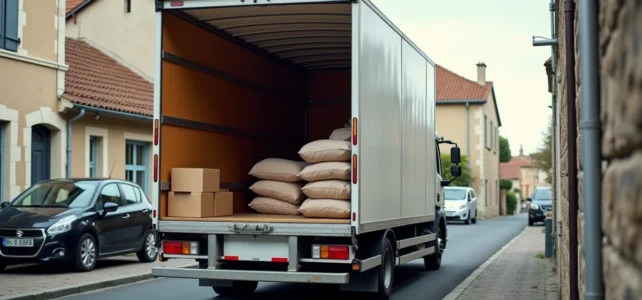
A 15m3 truck refers to a utility vehicle whose cargo space offers a volume of about 15 cubic meters. This volume corresponds to a combination of interior length, width, and height that varies depending on the models and rental companies. Understanding what this figure encompasses allows for precise anticipation of what fits in the truck, and especially what does not.
The starting point, before any list of furniture or boxes, remains the distinction between the announced volume and the payload in kilograms. These are two independent limits, and the more restrictive of the two dictates what the truck can actually carry.
See also : What You Really Need to Know About Pôle emploi Services: Reviews and Practical Tips
Volume and payload of a 15m3 truck: two limits not to be confused
Rental companies advertise 15m3 as volumetric capacity, but the authorized payload varies greatly from one vehicle to another. It depends on the GVW (gross vehicle weight), the empty weight of the truck, and the onboard equipment. For some models, the limit is around 1,200 kg, while for others it can be significantly different.
Filling the available volume does not guarantee compliance with the authorized weight. Boxes of books, dishes, or a safe can saturate the payload long before occupying all the space. Conversely, duvets and clothes fill the volume without being heavy. Checking the payload on the vehicle’s registration document on the day of pickup avoids dangerous overloads that may incur fines.
Related reading : Everything You Need to Know About Bazaar & Compagnie: Services, Activities, and History of the Store
To find practical information on Detectis Immo regarding capacity and suitable items for this size, the detailed fact sheet complements the rental company’s data usefully.
Interior dimensions of the 15m3: useful length, width, and height
The volume of 15 cubic meters results from indicative interior dimensions that, according to rental sources, are around 4.3 m in length, 1.8 m in width, and 1.9 m in height. These measurements vary from one manufacturer to another and even from one version to another within the same rental company.
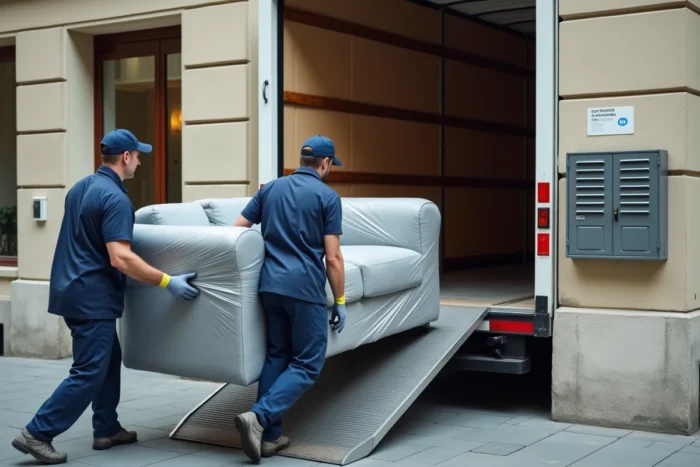
The usable length of about 4.3 m often constitutes the decisive criterion. It determines whether a three-seater sofa, a disassembled wardrobe, or wooden planks can fit flat without forcing. Before booking, measuring the longest items in the load and comparing them with the announced interior length remains the most cost-effective precaution.
The interior height, close to 1.9 m, allows for the vertical loading of a refrigerator or a standard wardrobe. The width allows for sliding a double mattress flat against a wall while leaving lateral space to secure boxes.
Box equivalence to estimate filling
Rental companies often translate volume into the number of standard boxes. For a 15m3, the common estimate is around 90 to 100 medium-sized boxes. This figure serves as a benchmark but assumes optimized stacking and boxes of uniform dimensions, which is rarely the case during an actual move involving furniture and various items.
Transportable items in a 15m3 truck: what fits and what doesn’t
A truck of this volume is generally presented as suitable for a T3 or T4 type dwelling. Specifically, the contents of a three to four-room furnished apartment typically fit within this size, provided that items that can be disassembled are taken apart and that there is no accumulation of heavy boxes.
Among the items that fit easily in a 15m3:
- A two or three-seater sofa, a double bed with its mattress, a dining table and its chairs, a standard dresser or Billy shelf
- Common appliances: refrigerator, washing machine, dryer, oven, microwave
- Several dozen boxes of clothes, dishes, books, small kitchen equipment, as well as various items like bicycles, rugs, or lamps
Items that pose problems are not always the bulkiest. An upright piano, for example, fits in volume but easily weighs over 200 kg, which disproportionately eats into the payload. Similarly, an empty aquarium fits in the truck, but its fragility makes transport risky without professional padding.
The case of long or atypical items
Planks, curtain rods over two meters long, or a step ladder fit thanks to the useful length of the van. However, a rigid kayak over 4.5 m or a fully extended ladder exceeds the interior capacity. For these borderline cases, measuring the item and comparing it with the announced usable length remains the only reliable judgment.
Loading order of a 15m3 truck: the method that protects the contents
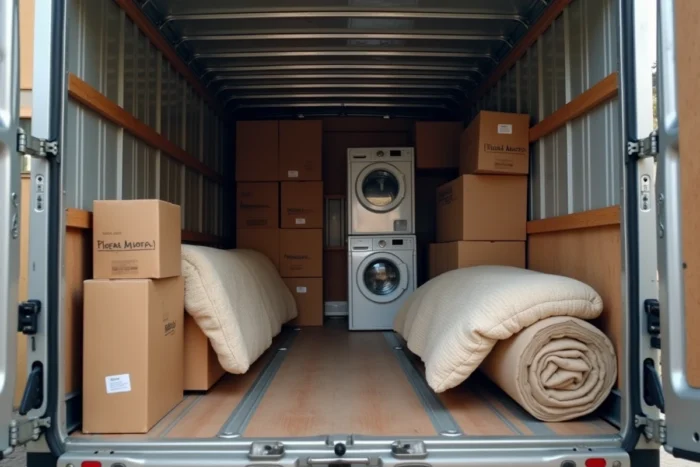
The available space is useless if poorly utilized. The most commonly shared rule among moving professionals can be summarized in one principle: heavy and bulky items against the cabin, light and fragile elements last.
Appliances (washing machine, refrigerator) and boxes of books go to the back, secured against the front wall. Disassembled furniture and mattresses are then placed vertically along the side walls, creating storage corridors for medium boxes. The last items loaded, near the rear doors, are the most fragile: mirrors, screens, boxes of wrapped dishes.
This distribution is not about comfort. It affects the vehicle’s center of gravity and stability during braking. An unbalanced load, with weight concentrated at the back or on one side, alters the truck’s behavior in turns and increases braking distances.
- Secure each item to prevent slipping: straps, protective blankets, boxes wedged without free space
- Do not stack heavy boxes on fragile furniture, even if it seems to optimize volume
- Leave minimal access to items that may be needed upon arrival (cleaning kit, assembly tools)
The 15m3 can be driven with a standard B license, provided that the driver has held the license for at least a year and meets the minimum age requirement, usually set at 21 years by rental companies. This size remains manageable in the city, but its external dimensions require increased vigilance in underground parking and under low bridges. Checking the total external height of the vehicle before each constrained passage avoids costly damages that rental insurance may not always cover.