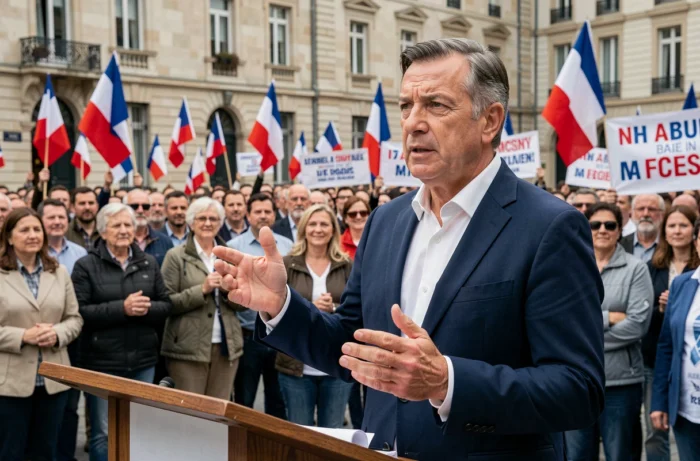
The Patriots is a French political party founded in 2017 by Florian Philippot, after his break with the National Front (now National Rally). The movement is structured around three axes: leaving the European Union, defending national sovereignty, and opposing restrictive health policies. As an extra-parliamentary party, it occupies a unique place in the French political landscape, balancing grassroots activism and a strong digital presence.
Ideological Line of the Patriots: Frexit as the Backbone
Unlike other sovereignist formations that modulate their discourse on Europe according to electoral deadlines, The Patriots make Frexit a permanent identity marker. Exiting the European Union, the eurozone, and NATO constitutes the programmatic foundation of the party since its inception.
Since 2025, the official communication of the movement further emphasizes this framing. The European Union is presented as a structural adversary of French sovereignty. The party’s social media publications daily revisit the cost attributed to European membership, with a recurring message that quantifies the French net contribution. This radical positioning on the European question distinguishes The Patriots from the National Rally, which has gradually abandoned Frexit in its program.
The party claims to be neither right nor left, seeking to unite what Florian Philippot calls “the best from the right and the left.” In practice, political observers place the movement on a spectrum ranging from sovereignist right to far-right, depending on the analytical frameworks used.
To track the evolution of these positions, the information on The Patriots published regularly allows for measuring the shifts in discourse over the months.
Electoral Results of the Patriots: A Party Without National Elected Officials
The electoral journey of The Patriots illustrates the structural difficulty of small French parties to break through in a system that favors large formations. The movement has presented candidates in several national and European elections without ever obtaining parliamentary representation.

In the European elections of June 9, 2024, the list led by Florian Philippot received 0.9% of the votes, without securing a seat in the European Parliament. This score, well below the threshold for representation, confirms a trend observed since the party’s first electoral participations.
This electoral marginality can be explained by several factors:
- The direct competition from the National Rally, which captures the bulk of the sovereignist electorate and occupies the media space on these themes
- The absence of local institutional relays (town halls, departmental or regional councils) that could serve as a basis for sustainable implantation
- Limited funding compared to parties represented in Parliament, as parties without elected officials do not benefit from public funding proportional to electoral results
The party compensates for this electoral deficit with a visibility strategy based on social media and street demonstrations, a model reminiscent of other European protest movements.
Grassroots Mobilization and Digital Strategy of the Patriots
The activity of the movement relies less on traditional electoral campaigns than on a permanent mobilization around thematic causes. During the health crisis, The Patriots organized or co-organized numerous demonstrations against the health pass, which constituted their period of highest media visibility.
This capacity for occasional mobilization has not translated into massive memberships or results at the polls. The movement offers several membership options (classic, support, youth, prestige), with amounts eligible for tax deduction, but the number of activists remains modest compared to the major parties.
On the geopolitical front, the party has taken strong positions on the Ukrainian conflict. Florian Philippot has called for an end to military support for Ukraine, a line that aligns with that of certain European sovereignist movements. This position, relayed by media close to Russia, has fueled controversies regarding the ideological proximities of the movement.

Internal Organization and Militant Training at Les Patriotes
The party has established a formal structure with statutes, an executive committee, a national team, and territorial referents. Florian Philippot has been its president since its founding. This centralized organization around a single leader is characteristic of personalist French parties.
Two initiatives deserve mention within the militant apparatus:
- The Academy of Patriots, an internal training program aimed at structuring the discourse of activists and preparing candidates for local elections
- The Young Patriots, a branch dedicated to those under 25, who benefit from a reduced membership fee and specific events
- A network of departmental referents responsible for energizing the local life of the movement and organizing grassroots actions (leafleting, gatherings, public meetings)
The party has faced internal difficulties, including dissent that led to the creation of La Gauche patriote in 2019. These tensions reflect the challenge of maintaining cohesion in a movement that claims to transcend the left-right divide while attracting a variety of ideological profiles.
The sustainability of The Patriots relies on their ability to occupy a niche that the major sovereignist formations have partially abandoned: that of assured Frexit and frontal opposition to European institutions. However, this radical positioning, while ensuring a clear identity, keeps the party in an electoral niche from which it has not managed to emerge since its creation.