
When writing a report, a professional email, or a document, the verb “faire” always ends up posing a concrete problem. We hesitate between “fais” and “fait,” confuse the passive voice with the future perfect, and waste time verifying. This third-group verb is one of the most commonly used in French, but also one of the most irregular. Understanding its mechanisms avoids mistakes that are poorly received in a formal context.
Past participle “fait”: the rule that resolves all hesitation
The most common trap is the hesitation between “fais” and “fait” in compound tenses. We write “j’ai fait,” “elle avait fait,” “nous aurons fait,” and never “j’ai fais.” The logic is simple: auxiliary plus faire always gives “fait” with a t.
This confusion comes from the present indicative, where “je fais” and “tu fais” are correctly written with an s. The brain associates the first person with the final s, then reflexively transposes it to the compound tenses. To get around this, we mentally replace it with another third-group verb: “j’ai pris,” not “j’ai pris-e.” The past participle has its own ending, independent of the present.
This principle directly applies to the two forms that interest us. “A été fait” uses the past participle in a passive construction (auxiliary être). “Aura fait” uses it in the future perfect (auxiliary avoir). In both cases, we find examples of a été fait and aura fait that illustrate this constant: the final t does not change, only the agreement in gender and number can vary with the auxiliary être.
Irregular conjugation of the verb faire in problematic tenses
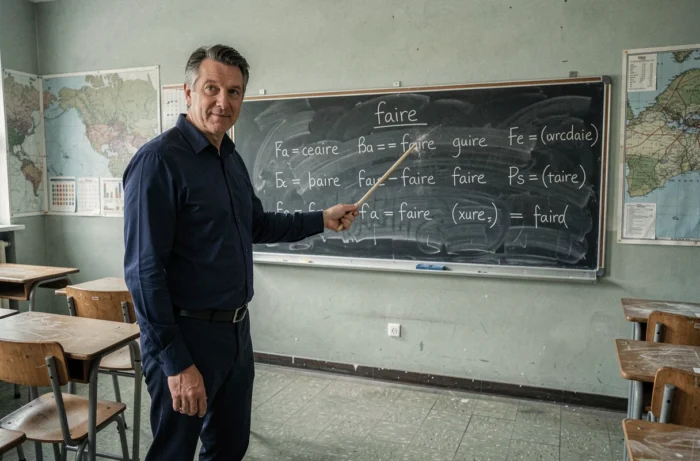
We will not go through the complete tables found everywhere. Let’s focus on the points where mistakes are real.
Present indicative: the form “vous faites”
The root changes according to the persons. We write “nous faisons” (with the root fais-), but “vous faites” and never “vous faisez”. This irregularity also concerns all derivatives: défaire, refaire, satisfaire. We will say “vous satisfaites aux critères,” not “vous satisfaisez.”
Another phonetic subtlety: in “nous faisons” and in the imperfect (“je faisais”), the letters “ai” are pronounced like a mute e, while in “je fais” or “vous faites,” they sound like “è.” The spelling remains the same, but the pronunciation varies.
Simple future and conditional: the root fer-
In the future, the verb faire completely abandons its usual root. We write “je ferai,” “tu feras,” “il fera.” In the conditional: “je ferais,” “nous ferions.” The root fer- replaces fais- without exception in the future and the conditional.
Present subjunctive: the root fass-
Another radical transformation: “que je fasse,” “que nous fassions.” We find this root only in the present subjunctive. It is a form to memorize by heart, as no derivation rule allows us to deduce it.
Passive voice and future perfect: distinguishing “a été fait” and “aura fait”
These two constructions use the same past participle, but their grammatical mechanics differ. Confusing them muddles the meaning of a sentence.
“A été fait”: the passive construction
The passive voice is formed with the conjugated auxiliary être, followed by the past participle. “Le travail a été fait” means that someone has completed the work, but we emphasize the result rather than the author of the action. With the auxiliary être, the past participle agrees with the subject: “la demande a été faite,” “les rapports ont été faits.”
- “La réparation a été faite hier”: feminine singular subject, agreement in -e.
- “Les essais ont été faits en laboratoire”: masculine plural subject, agreement in -s.
- “Les corrections ont été faites avant la relecture”: feminine plural subject, agreement in -es.
“Aura fait”: the future perfect
The future perfect is constructed with the auxiliary avoir in the simple future, followed by the past participle. “Il aura fait le nécessaire avant vendredi” expresses a completed action in the future. With the auxiliary avoir, there is no agreement with the subject: “elle aura fait,” “ils auront fait.”
Agreement only occurs if a direct object complement precedes the verb. “Les démarches qu’il aura faites” takes an -es because “démarches” (feminine plural) is placed before. Opinions vary on the actual difficulty of this rule, but in daily practice, the majority of sentences in the future perfect do not have a preceding direct object.

Common meanings of the verb faire in a professional context
The verb faire functions as a catch-all verb. In writing situations, we gain precision by identifying what it actually replaces.
- To realize or accomplish: “faire un rapport” means to write it. In formal writing, “rédiger un rapport” will always be more precise.
- To provoke a state: “faire peur,” “faire plaisir.” Here, faire acts as a semi-auxiliary followed by a noun.
- To replace a previously mentioned verb: “Il travaille plus vite que ne le fait son collègue.” This verbal reprise is correct and avoids repetition.
- To construct a causative structure: “faire réparer la machine” means to ask someone else to repair it. The past participle “fait” followed by an infinitive remains invariable in the causative construction: “la machine qu’il a fait réparer,” without agreement.
This last point is a classic in dictations and grammar exams. The invariability of the past participle before an infinitive in the causative construction has been confirmed by spelling reforms, simplifying the rule.
The verb faire remains a versatile tool as long as one masters its irregular forms and agreement rules. The distinction between “a été fait” (passive, agreement with the subject) and “aura fait” (future perfect, agreement with the preceding direct object only) covers the vast majority of problematic situations. When doubt persists, replacing faire with a verb from the same group allows for quick verification of the ending in a few seconds.